Fort Wayne
A spirit of enterprise
Published .
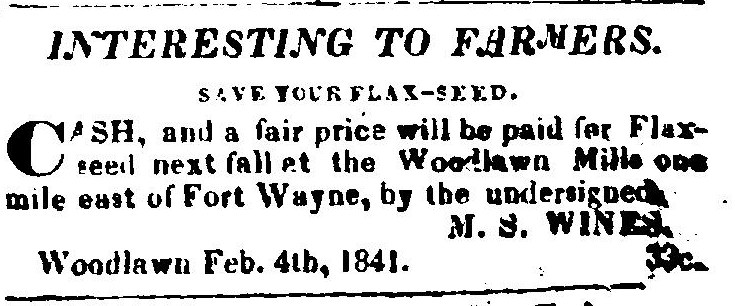
In the winter of 1841 Marshall S. Wines put a notice in the Fort Wayne Sentinel asking farmers to save their flax-seed. "CASH, and a fair price will be paid for Flax-seed next fall at the Woodlawn Mills one mile east of Fort Wayne," it said, and he signed it from Woodlawn on 4 February.
He had been building mills in Allen County for seven years by then. In 1834 he and a partner named Blair put up a sawmill on Cedar Creek, in what became Perry Township, and later added a corn-cracker to it. A county historian writing in 1880 did not think much of the corn-cracker. Its stones were about eighteen inches across and worked upright. "It ground very coarsely, merely cracking the kernels," he wrote. "It was a very primitive affair, and of little good to its proprietors or the settlement. The saw-mill, however, was a good investment, and yielded its proprietors a fair revenue." Samuel Shryock bought it in 1836 and sent to Dayton, Ohio, for a run of buhrs.
In 1838 Wines bought a sawmill on the south bank of the Maumee that a man named Coles had built, about ten rods east of where the Hanover Street bridge would later cross the canal. According to the same historian, Wines "erected immediately east and adjoining it a grist-mill." That was the Woodlawn Mills. Settlers in Monroe Township, with no mill of their own, carried their grain to Wines' mill on the Maumee or to Rudisill's on the St. Joseph, trips of six or seven days.
Wines was a canal contractor first and a miller second. He was called Colonel. He sat as an associate judge, and in 1841 the Sentinel announced him as a candidate for the legislature. Allen County elected him.
The flax-seed notice ran in the issue of 27 March 1841. In the next column was a sheriff's sale. Joseph Berkey, the sheriff, had a writ "against the goods and chattles, lands and tenements of Henry Work and Marshal S. Wines as bail." Wines had put his name to another man's debt, and the debt had come due. Berkey levied on 82 acres in Section 7 of Township 30, "taken as the property of said Wines," and offered the rents and profits for seven years at the courthouse door on 29 March. If the rent would not cover the debt and cost, he would sell the land outright.
It did not settle. In June the notice ran again under a second writ, with a new sale day of 5 July. What happened at the courthouse door that Monday is not in the paper. Nor is it in any later issue held.
By July 1842 two men named Taylor and Freeman were buying wheat for cash "at the Woodlawn Mills, (late Col. Wines')." Wines was alive. The mill was no longer his. In August the Sentinel reported that Allen County had re-elected him.
Then he went south to his canal work. On 24 September 1842 the Sentinel announced "the death of Col. MARSHALL S. WINES, Representative in the state legislature from this county. He died at Attica, Fountaine co., on Wednesday morning last, of congestive fever." That Wednesday was 21 September. Later county histories put his death in 1842 without a day.
A week later a correspondent who did not sign his name filled a column. Wines had gone to Attica "but a few weeks before, for the purpose of attending personally, for a short time, to his contract on the Wabash and Erie Canal, his wife and children being with him." He had been born in New Jersey, moved young to New York and come to Indiana about ten years earlier. He was "one of the most competent and efficient Canal Contractors in the west."
The correspondent did not stop at praise. "His faults are attributable to a spirit of enterprise, which sometimes outstripped his means, and left him without the power of fulfilling his engagements. A small business and a limited field of operations, were not consistent with his taste and his ambition."
In October Samuel Hanna, Hugh McCulloch and O. W. Jefferds took out administration of his estate. Their notice ended with one line. "The estate is supposed to be insolvent." For years afterward the bank's lists of land for sale carried parcels taken on debts "against the heirs" of Marshall S. Wines.
The mill outlasted him. In December 1858 the Sentinel reported that Bostick and Fronefield had bought "the well known Woodlawn Mills, on the Maumee, just below the city, formerly Col. Wines', and more recently Hanna's." It ran under a string of owners until it burned in 1879.
The Woodlawn name also went with a country seat about a mile east of town on the old Piqua road. Whether it was the same ground as the mill, no source held says. The St. Paul's Lutheran congregation bought it after his death. The 1880 historian gives the year as 1849 and calls Wines "then lately deceased," though he had been dead for seven years. In 1917 B. J. Griswold wrote of "Woodlawn," "the beautiful country estate of Colonel Marshall S. Wines; it forms the present Concordia college grounds."
Sources
- Fort Wayne Sentinel, 27 March 1841. Internet Archive. Scan leaf n6. The flax-seed notice and the sheriff's sale
- Fort Wayne Sentinel, 26 June 1841. Internet Archive. Scan leaf n6. The second writ
- Fort Wayne Sentinel, 30 July 1842. Internet Archive. Scan leaf n3. Taylor and Freeman
- Fort Wayne Sentinel, 24 September 1842. Internet Archive. Scan leaf n1. The death notice
- Fort Wayne Sentinel, 1 October 1842. Internet Archive. Scan leaf n3. The correspondent
- Fort Wayne Sentinel, 17 December 1842. Internet Archive. Scan leaf n6. The administrators
- Fort Wayne Sentinel, 29 June 1850. Internet Archive. Scan leaf n2. Against the heirs
- Fort Wayne Sentinel, 18 December 1858. Internet Archive. Scan leaf n1. Bostick and Fronefield
- History of Allen County, Indiana, Kingman Brothers, 1880. Internet Archive. Scan leaves n111, n144, n261, n276
- The Pictorial History of Fort Wayne, Indiana, B. J. Griswold, 1917. Internet Archive. Printed page 360, scan leaf n371; scan leaves n356 and n416
The text was read from scanned images. Every quotation was checked against the page image.
More from Fort Wayne
Fort Wayne
A total loss to the Seminary Fund
The county's first school was meant to be paid for by the fines of its courts. In 1841 the clerk counted $3,392.70 in fines and forfeitures since 1824, and $238.31 collected. In 1860 one of the seminary's lots was forfeited back to the fund.