Allen County
Its house of Burgesses
Published .
In the spring of 1842 Henry Burgess took over the post office at Kendall, in Adams Township, and the Fort Wayne Sentinel did not like it.
"Mr. Rufus McDonald has been recently removed from the post-office at Kendall, in this county, and Mr. Henry Burgess appointed in his stead," the paper said on 16 April. The Sentinel was a Democratic paper. "This removal shows the underhanded means by which such business is accomplished in these glorious Whig times."
The paper had a way to prove its point. At the township election that spring the citizens of Adams had put up the old postmaster and the new one for road supervisor, and McDonald's vote, the Sentinel reported, "was a fraction over 22 to 1 that of Mr. Burgess." Its advice followed. "Mr. Burgess would better consult his honor and his good name among his neighbors, by taking the hint so unequivocally given him at the election."
The rival Times answered that Burgess had never been a candidate. The Sentinel came back on 7 May. It had been assured by several citizens of Adams township "that Mr. Burgess not only was a candidate, but that he electioneered for votes, and was present at the polls." Of eight subscribers whose papers went to Kendall, it added, seven had asked for them to be carried privately to McDonald's house instead, "and one has his paper sent to the new office."
He did not resign. He moved the office.
Burgess had been building a town about three years by then. The land lay along the Wabash and Erie Canal east of Fort Wayne, a tract a man named Gundy had entered and girdled and left, so that it was known as Gundy's Deadening. Samuel Hanna sold it to Eben Burgess, who had farmed in the township since 1834, and in 1839 it was cut into town lots and named New Haven. The county's historians do not agree on how. The first said Eben sold the land to his son and that Henry laid out the lots, recorded in June 1839. The next, nine years later, said father and son made the plat together, on 16 March. The plat book that would settle it has not been examined. The lots, at any rate, were Henry's: in 1857 a house in New Haven stood on "Lot No. fifty one (51) in H. Burgess' Addition."
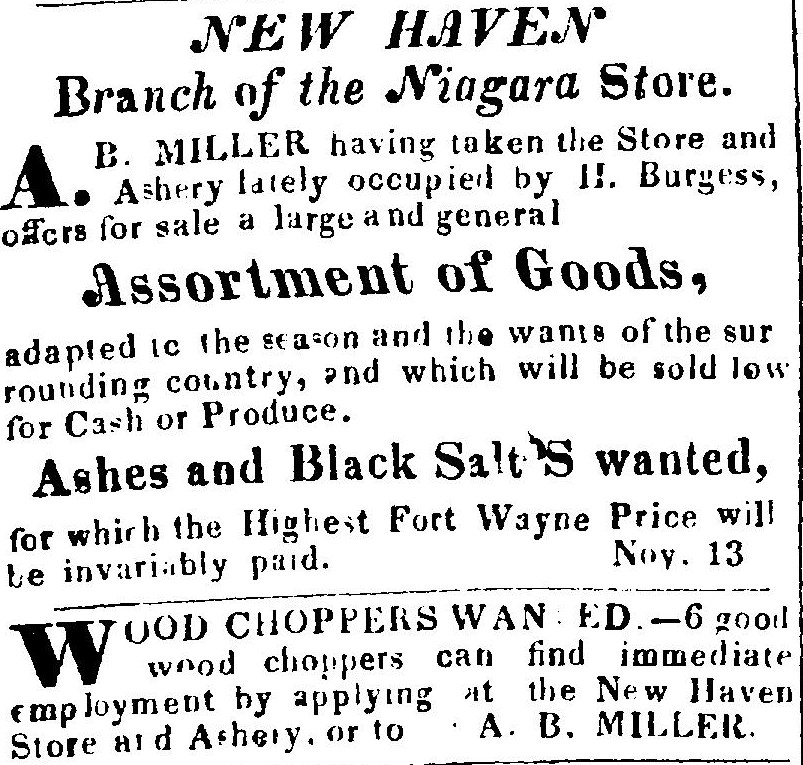
By the first county history, Henry kept the first store in the village, on the north side of the canal. By 1841 his name ran in the Sentinel among the places a patent medicine could be bought, "Henry Burgess New Haven," between the Fort Wayne druggists and a merchant in Jefferson. He ran an ashery with it. In November 1847 the store changed hands. "A. B. MILLER having taken the Store and Ashery lately occupied by H. Burgess," the notice read, "offers for sale a large and general Assortment of Goods, adapted to the season and the wants of the surrounding country." Under it Miller asked for ashes and black salts.
The post office, meanwhile, had come to New Haven. During his term, the first county history says, Burgess "removed the office to New Haven, where it has since remained." Kendall's office took the new town's name. Rufus McDonald was postmaster again later, and kept the office until 1856.
That same history tells the quarrel differently. McDonald, it says, "kept the office until 1842, when he resigned." It does not say who told the historian so. The Sentinel of 1842 said he was removed. The two accounts cannot both be right, and the paper that printed the 22 to 1 vote was no friend of the man it counted against.
Among the volunteer toasts at the Fourth of July celebration in 1851, W. H. McDonald raised a glass to "The village of Hoosier New Haven: Though not so old as its Yankee namesake, by a couple of centuries, yet it has its house of Burgesses."
In 1866 the Methodist Episcopal society in New Haven was still meeting in a building borrowed from the Methodist Protestants. The first county history tells what happened next: "Henry Burgess resolved to erect a house for the Lord, in which His people might worship Him. Agreeably with this resolve, a neat brick structure was begun, and in due time completed, and presented to the proper officers." It was dedicated on 24 February 1867.
The historian named where that account came from, in a note at the foot of the page. It was compiled from a sketch written by one of the church's pastors, "kindly loaned to the writer by Mr. Henry Burgess." The church's story reached the county's first history from the man who built the church. No other account of it is independent of that one.
In March 1859 Burgess took up a stray cow in Adams Township and advertised it in the Sentinel, as the law required. It was a light brindle red cow, with a white face and a white line down the back, a swallow fork in the left ear, and the tip of the tail white. Two neighbours appraised her at eleven dollars.
Sources
- Fort Wayne Sentinel, 27 March 1841. Internet Archive. Scan leaf n8. Henry Burgess, New Haven
- Fort Wayne Sentinel, 16 April 1842. Internet Archive. Scan leaf n3. The Kendall post office
- Fort Wayne Sentinel, 7 May 1842. Internet Archive. Scan leaf n3. The Sentinel's reply
- Fort Wayne Sentinel, 27 November 1847. Internet Archive. Scan leaf n2. A. B. Miller
- Fort Wayne Sentinel, 12 July 1851. Internet Archive. Scan leaf n1. The volunteer toasts
- Fort Wayne Sentinel, 30 May 1857. Internet Archive. Scan leaf n2. H. Burgess' Addition
- Fort Wayne Sentinel, 26 March 1859. Internet Archive. Scan leaf n2. The estray
- History of Allen County, Indiana, Kingman Brothers, 1880. Internet Archive. Adams Township, scan leaves n205 to n207
- Valley of the Upper Maumee River, 1889. Internet Archive. Scan leaf n218
- The Pictorial History of Fort Wayne, Indiana, B. J. Griswold, 1917. Internet Archive. Scan leaf n614
The text was read from scanned images. Every quotation was checked against the page image.