Fort Wayne
The Edsalls know no such word as fail
Published .
On a Thursday in March 1844, Samuel Edsall stood up in the clerk's office in Fort Wayne and asked the men there for a bridge. He wanted it over the St. Mary's, on the west side of town, where the Ewing and Rockhill additions sat waiting for trade. Business, he told them, was being pulled toward another quarter of the city. The meeting agreed with him. Two weeks later the editor of the Sentinel reported that the bridge at the foot of Ewing Street had been put under contract, and whose contract it was.
"The contract was taken by S. Edsall & Co.," he wrote. "From the well known energy and go-aheadativeness of the Major, we have no doubt the bridge will be done within the time specified."
The time specified was July. Whether it was met, the papers do not say.
By 1831 he was half of Hanna & Edsall, the firm the county commissioners hired to do the carpentry on the first courthouse and to furnish "all lumber, timber, nails, glass, etc." Ten years later the commissioners wanted a larger building. Edsall took that contract too, and the county's own record, as a county history copied it out in 1880, says the new courthouse "was erected by Samuel Edsall, the contractor, and completed in 1847. This was a two-story edifice, of brick". Between the two he built a flour mill beside the St. Mary's aqueduct.
The work that asked the most of him was a road.
In January 1850 the directors of a new plank road company met to lay a road from Fort Wayne south to Bluffton, through the woods of Allen and Wells counties. Samuel and his brother William offered to build all of it, gate houses, culverts and bridges included, "for $1600 per mile, taking $12,000 stock in part payment." The offer was accepted. The brothers said they would put up three steam sawmills along the route to cut the plank themselves.
A week later a committee in Wells County set out the terms from its end. The county's interest, it reported, would be served by "giving Major Edsall the contract to build and complete the said contemplated plank road between this place and Fort Wayne," provided he finished by the first day of December 1850 and took 12,000 dollars of stock. The contractor was to be a shareholder. He would be paid, in part, in the road.
By November the Sentinel could count ten miles of plank, from the steam mill six miles south of the city to Ossian, with a gap of about a mile in the middle. Neither end was done. The editor described the ground they had been cutting through as "flat and very wet, densely timbered, with a heavy clay soil." Then he explained why it had gone slowly. The stockholders had been "very backward in paying their subscriptions," and the Edsalls had "not as yet received more than $6,000 or $7,000 on the work, much of it in trade and unavailable means."
"But the Edsalls know no such word as fail," he went on, "and anything they undertake is bound to go through."
The December deadline passed with the road unfinished. In June 1851 a traveller writing home to the Bluffton paper caught a ride north from Ossian "with Major Edsall, the go-a head enterprising Plank Road Contractor," and reported that the road, "as far as completed, is as good, if not better, than any I have been over." When the last plank went down is not in any record held.
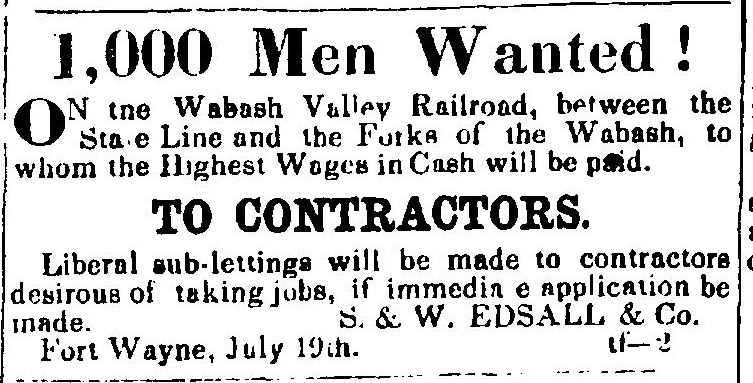
The contracts kept coming. In the summer of 1853 the brothers' firm was advertising for men and sub-contractors on the railroad grade between the Ohio line and the Forks of the Wabash. In August 1859 a new pivot bridge over the canal on Calhoun Street opened, "reflecting great credit on the builders Messrs. Edsall & Kimball." While the old bridge was being pulled out, a stick of timber dragged across the deck crushed one of Edsall's feet. The paper did not give his first name.
In January 1860 the commissioners opened bids for a third courthouse. Samuel Edsall & Co. won it, with V. M. Kimball again beside him, and in July 1862 the superintendent certified that "the Court House built by S. Edsall & Co. is completed according to the plans and specifications."
Edsall died in February 1865, according to a county history of 1889. The corner stone of the courthouse he contracted for listed everyone who had a hand in it, and the 1880 history copied it down line by line:
"Contractors: S. Edsall and V. M. Kimball. Designed by Edwin May. Superintendent, Michael McElfatrick. Builder, D. J. Silver."
Sources
- Fort Wayne Sentinel, 9 March 1844. Internet Archive. Scan leaf n3. The bridge meeting
- Fort Wayne Sentinel, 23 March 1844. Internet Archive. Scan leaf n5. The bridge contract
- Fort Wayne Sentinel, 26 January 1850. Internet Archive. Scan leaf n1. The plank road offer
- Fort Wayne Sentinel, 2 February 1850. Internet Archive. Scan leaf n1. The Wells County committee
- Fort Wayne Sentinel, 2 November 1850. Internet Archive. Scan leaf n1. The plank road in November
- Fort Wayne Sentinel, 28 June 1851. Internet Archive. Scan leaf n2. A letter from the Bluffton Banner
- Fort Wayne Sentinel, 20 August 1853. Internet Archive. Scan leaf n2. S. and W. Edsall and Co.
- Fort Wayne Sentinel, 27 August 1859. Internet Archive. Scan leaf n1. The canal bridge on Calhoun Street
- History of Allen County, Indiana, Kingman Brothers, 1880. Internet Archive. Scan leaves n57 and n60
- Valley of the Upper Maumee River, 1889. Internet Archive. Scan leaf n199
The text was read from scanned images. Every quotation was checked against the page image.
More from Fort Wayne
Fort Wayne
A total loss to the Seminary Fund
The county's first school was meant to be paid for by the fines of its courts. In 1841 the clerk counted $3,392.70 in fines and forfeitures since 1824, and $238.31 collected. In 1860 one of the seminary's lots was forfeited back to the fund.