Fort Wayne
As true to nature as the reflection in a mirror
Published .
In the autumn of 1843 a man named Charles E. Keith took rooms in Colerick's brick building in Fort Wayne, opposite Hamilton & Williams' store, and set out a camera.
He put a notice in the Sentinel dated 4 November. He offered "Colored Daguerreotype Miniatures," and he described the trade in terms his readers had not seen used about their own town. "Photography having undergone a complete change by a series of valuable improvements, is now a truly wonderful art," he wrote. A single portrait in an embossed morocco case with a gilt border cost $3. A group of two or more cost $4. There was a deduction where several were taken from one family.
The editor of the Sentinel went to look. He printed a paragraph the same week.
"Mr. Keith is at present in our city, taking likenesses, by the newly invented Daguerreotype process. What this process is we can hardly explain to our readers, and would therefore advise them to call at the artist's room in Mr. Colerick's Brick Building, and see for themselves."
He tried anyway. A likeness of any person, he wrote, "is transferred to a silver plate in the short space of one to two minutes, and the likeness must in every instance be as true to nature as the reflection in a mirror."
He added a warning. "As Mr. K's stay here will be but short, those who wish really good and correct likenesses would do well not to delay calling on him."
The advertisement did not appear again in the issues that survive. Neither did Keith.
Four weeks later the same paper had another daguerreotypist to announce, and this one lived in the town. On 2 December the editor wrote that "our fellow citizen J. L. Hubbell, is prepared to take likenesses by the improved Daguerrean process."
"Likenesses taken by this process are of necessity correct," he went on, "as much so as the reflection of your image in a mirror."
It was the mirror again, a month on, from the same desk. The editor then gave the town a reason to hurry. "As beauty is fleeting, and old Time with his heavy hand might plough wrinkles in the fairest face before another opportunity offers, these who think themselves handsome enough to be put in a frame had better embrace the present chance, and 'go it while they're young.'"
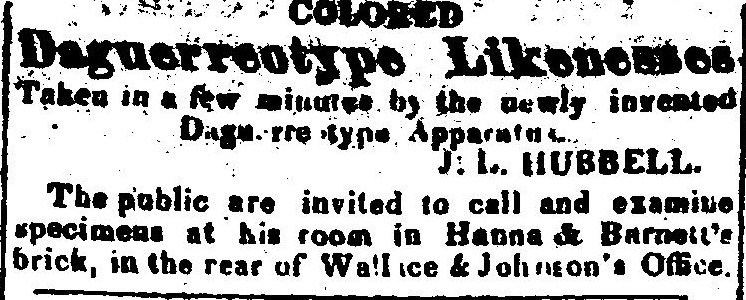
Hubbell's own advertisement ran below it. "Colored Daguerreotype Likenesses," it read, "taken in a few minutes by the newly invented Daguerreotype Apparatus." The public were invited to examine specimens at his room in Hanna & Barnett's brick building, in the rear of Wallace & Johnson's office.
He printed no prices. Keith had printed his. What Hubbell charged is not in the paper.
A week later, on 9 December, the editor had one more line. Mr. Hubbell, he understood, purposed remaining in the city one week longer. The advertisement was still running on 23 December. After that the paper does not mention a daguerreotype in Fort Wayne for a year and a half.
The Sentinel's file for those months is close to complete. The issues from October through the 23rd of December survive, and none of them before 4 November names a daguerreotypist. No issue of 1841 or 1842 does either. That shows who was first to advertise in that paper. It does not show who was first to take a likeness in the town, because a man could work a week in a hotel room and never buy a line of type.
In June 1845 a third one came. I. L. Teliga informed "the Citizens of Fort Wayne and neighborhood that he will remain in this place for a short time, and will take likenesses by the improved Daguerrean process." He showed his specimens at the American.
Seventy-four years after Keith's notice, B. J. Griswold wrote the town's history of these weeks in three sentences. "A Mr. Keith was the first to open a studio," he wrote. "J. L. Hubbell, a second daguerreotype artist, came in the same year." He named neither man's source, and gave Keith no first name.
The order he gave is the order in the paper. The first name, the rooms, the price and the four weeks between them are in the paper too, dated and signed.
Keith's advertisement closed the way most of them did. "The public are respectfully invited to call and examine specimens."
Sources
- Fort Wayne Sentinel, 4 November 1843. Internet Archive. Scan leaf n5 and n1. Charles E. Keith's advertisement, dated 4 November, and the editor's notice
- Fort Wayne Sentinel, 2 December 1843. Internet Archive. Scan leaf n5. The editor's notice of J. L. Hubbell, and his advertisement
- Fort Wayne Sentinel, 9 December 1843. Internet Archive. Scan leaf n6 and n7. The editor's notice, and the advertisement
- Fort Wayne Sentinel, 16 December 1843. Internet Archive. Scan leaf n5. The advertisement
- Fort Wayne Sentinel, 23 December 1843. Internet Archive. Scan leaf n4. The advertisement
- Fort Wayne Sentinel, 12 July 1845. Internet Archive. Scan leaf n2. I. L. Teliga, dated 25 June 1845
- The Pictorial History of Fort Wayne, Indiana, B. J. Griswold, 1917. Internet Archive. Printed page 370, "The First Daguerreotypes", scan leaf n381
The text was read from scanned images. Every quotation was checked against the page image.
More from Fort Wayne
Fort Wayne
Without any provocation
A private pleaded guilty to rioting in the public cornfield. Three men were then sworn, and what they said was not about the riot. The commanding officer punished the other man too, without charging him.