Fort Wayne
Opposition on the canal
Published .
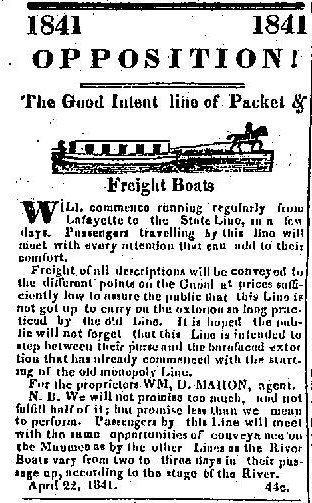
In April 1841 William D. Mahon bought space in the Fort Wayne Sentinel and headed it with one word in heavy capitals. "OPPOSITION!"
Under it ran a woodcut of a long cabin boat drawn by a horse with a rider on its back, and the name of the line. The Good Intent line of packet and freight boats would begin running regularly from Lafayette to the State Line in a few days. Passengers would meet with every attention that could add to their comfort. Freight would go to the points on the canal at prices low enough, Mahon wrote, to show the public that his line had not been got up to carry on the old line's long practice of extortion.
Then he said what the line was for.
"It is hoped the public will not forget that this Line is intended to step between their purse and the barefaced extortion that has already commenced with the starting of the old monopoly Line."
He signed it for the proprietors, as agent, and added a line underneath: "We will not promise too much, and not fulfill half of it; but promise less than we mean to perform." The notice was dated 22 April 1841.
The old line was directly below it on the same page. The Wabash & Erie Transportation Co. would run a daily line of boats for passengers and freight from Lafayette to a point in Ohio six miles beyond the state line, making 146 miles. Its boats would meet a line of stages at the end of the canal in Ohio, and it would run boats on the Maumee to the lake. "Fare will be reduced so as to meet the expectations of a generous public." It was dated at Fort Wayne on 3 April and signed by three men: Sam'l Mahon, L. G. Thompson and F. Comparet.
So in the spring of 1841 a reader of the Sentinel found two lines running the same water, and a Mahon signing for each.
Neither advertisement printed a fare. The old line promised a reduction and the new one promised to undercut the old, and neither said by how much. What the boats actually charged that summer is not in the paper.
The two notices ran side by side, week after week, through the season. In August a third man joined them. John Barber announced a new and fast-running canal boat, the Red Bird, carrying passengers and freight from Lafayette to the State Line and all the ports between, and asked travellers to give him a fair trial. He could carry them and their freight, he wrote, "as cheap and swift as any other person, and a leetle cheaper."
The Good Intent notice last appears in the issue of 20 November 1841. The Transportation Co. notice stops at about the same time. Through 1842, neither line advertised in the Sentinel at all.
The next time William D. Mahon appeared in the paper, it was under a justice's name. On 4 January 1842 Henry Lotz, a justice of the peace in Wayne Township, issued a writ of domestic attachment against his goods, chattels, credits and effects, on the affidavit of Thomas J. Lewis. By virtue of the writ, the notice said, "one grey poney, one grey horse, one bay horse and set of harness" had been attached as Mahon's property. Lotz would hear the matter at his office on 1 February. The notice does not say what Mahon owed, or to whom beyond Lewis, or whether the horses were the ones that had pulled the Good Intent's boats.
No later issue held for 1842 reports how Lotz decided. After February, William D. Mahon's name turns up only on the post office's list of letters waiting to be called for.
Whether the two Mahons were kin, the paper never says. Forty-eight years later a county history wrote that "Samuel and Archie Mahon began running packets between Toledo and Fort Wayne" in 1843, two years after Samuel had signed for the old line. In 1917 B. J. Griswold named "the four Mahon brothers, Samuel, Archie, William and Monroe," as the principal owners of an important line of packets. Griswold gave no middle initial for William and did not say where he had it from. Nothing in the advertisements of 1841 settles whether his William was the agent of the Good Intent.
The line Griswold described carried boats named the Indiana, the Clyde, the Wabash and the Chief Richardville. The last of them, he wrote, was built by Francis Comparet.
Sources
- Fort Wayne Sentinel, 22 May 1841. Internet Archive. Scan leaf n6. The Good Intent advertisement, dated 22 April 1841, and the Wabash & Erie Transportation Co. advertisement, dated 3 April 1841
- Fort Wayne Sentinel, 7 August 1841. Internet Archive. Scan leaf n2. John Barber's Red Bird, dated 4 August 1841
- Fort Wayne Sentinel, 20 November 1841. Internet Archive. The last printing of the Good Intent advertisement
- Fort Wayne Sentinel, 8 January 1842. Internet Archive. Scan leaf n5. Henry Lotz's notice of domestic attachment, dated 4 January 1842
- Volume 2 of the Valley of the Upper Maumee River, 1889. Internet Archive. Scan leaf n19
- The Pictorial History of Fort Wayne, Indiana, B. J. Griswold, 1917. Internet Archive. Printed page 340, scan leaf n351
The text was read from scanned images. Every quotation was checked against the page image.
More from Fort Wayne
Fort Wayne
Without any provocation
A private pleaded guilty to rioting in the public cornfield. Three men were then sworn, and what they said was not about the riot. The commanding officer punished the other man too, without charging him.