A carrying place of nine miles
Published .
A lieutenant of the Rangers went up to the Miami town in the late autumn of 1760 to take the French garrison off it, and stayed. He spoke French, which is why he was chosen. By February he was still there, holding the post with a few men, provisioned to spring, and he had sent a French trader down to Fort Pitt for goods because the people around him had nothing.
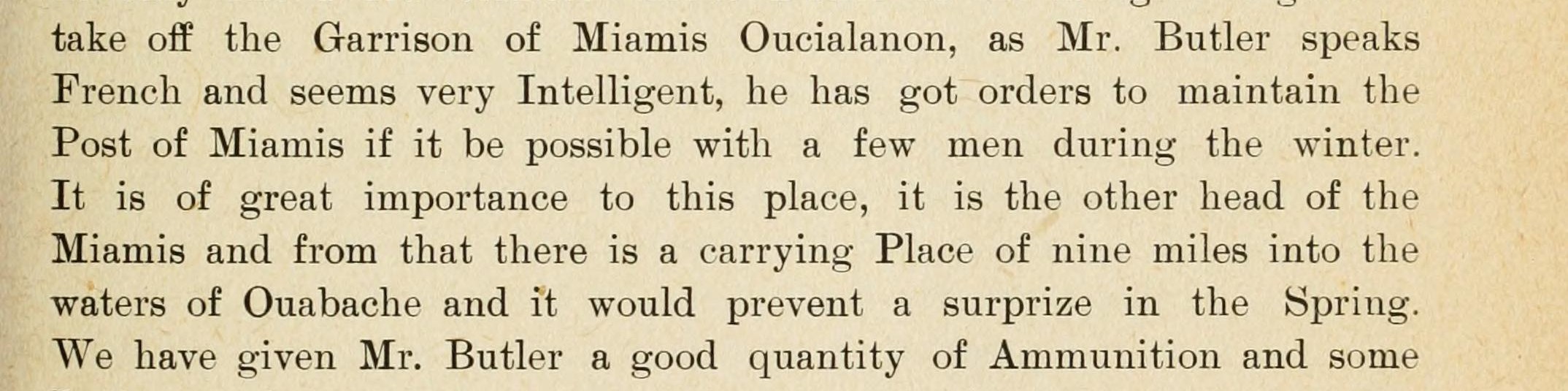
Butler had already gone when his commanding officer sat down at Detroit on 11 December 1760 to explain to Colonel Henry Bouquet why it mattered. Captain Donald Campbell had taken possession of Detroit not long before, was short of everything, and counted his barrels of pork in the same letter. Then, between a note about Michilimackinac and a note about Indian affairs, he gives his reason for holding a distant post through a winter.
Lieut Butler of the Rangers is gone to take off the Garrison of Miamis Oucialanon, as Mr. Butler speaks French and seems very Intelligent, he has got orders to maintain the Post of Miamis if it be possible with a few men during the winter. It is of great importance to this place, it is the other head of the Miamis and from that there is a carrying Place of nine miles into the waters of Ouabache and it would prevent a surprize in the Spring.
Three reasons in one sentence. It is the other head of the river. There is a portage of nine miles into the Wabash watershed. Holding it means not being surprised in the spring. Campbell does not mention trade and he does not mention the Mississippi. He is a soldier writing about a route.
In 1917 that sentence was quoted in a book about this town. B. J. Griswold put it in a note to his sixth chapter, attributed to Campbell and to Bouquet, in quotation marks:
Lieutenant Butler and his rangers are living among the Ottawas at the Miami post. At the post where he is stationed, he is but nine miles from the Wabash.
A carrying place of nine miles has become a distance of nine miles. The first is a thing men carry boats across, the second is a measurement on a map. The Ottawas have arrived from somewhere; they are not on Campbell's page. And the sentence giving the reason, that it is of great importance to this place, is gone.
A few lines above, on whether Ensign Robert Holmes came up with Butler, he writes that Holmes "appears to have accompanied" the party, flagging his own inference as one. What happened here happened to one sentence.
What the sentence was about kept costing money. In March 1763 Major Henry Gladwin at Detroit wanted four horses for the portage. His request went up to General Jeffery Amherst in New York, who wrote to Bouquet on the thirteenth.
I have a Letter from Major Gladwin, wherein he acquaints me that four Horses are much wanted for the Carrying Place at Miamis, and as they are extravagantly Dear in that Country, he wishes they could be sent from Below. I imagine they can be procured by Captain Ourry at a pretty Reasonable Rate
Bouquet answered four days later, on the seventeenth, and had already decided where to shop.
I write to Capt. Callendar to buy four good Horses fit for carrying Burthens at Carlisle where they may be had cheaper than at Bedford, and to send them with his own at the end of this month to the Detroit. Captain Ourry will pay for them & write to Major Gladwin that they are sent by your orders for the service of the Miamis.
Four horses, bought at Carlisle because Carlisle undercut Bedford, to walk to Detroit and then to the head of the Maumee. Whether they arrived is not in the record.
When Campbell sent a lieutenant on to take Ouiatanon in November 1761, a year after Butler went to the Miamis, he wrote that he "purchased indian corn at Miamis for that Garrison and Ouiatanon". The corn for two British posts on the Wabash was bought here.
It lasted two and a half years. On 12 July 1763 Lieutenant James MacDonald wrote to Bouquet from Detroit, setting down what Detroit had been told on 5 June.
Sunday the 5th of June we were acquainted that Fort Miamis was taken, that Ensign Holms who commanded them, had been informed (by two Frenchmen who arrived there the preceeding day) of Detroit being attacked by the Indians, which he would hardly believe, but threatened to imprison the French for that Report. That an Indian woman had betrayed him out of the Fort by Pretending that another woman was very sick, and begged him to come to her Cabbin to let Blood of her, and when he had gone a little distance from the Fort was fired on and killed.
The serjeant ran to the firing and was taken. The soldiers shut the gates and would probably have defended the fort, MacDonald says, had a trader taken a few days before not advised them to open. They opened, and grounded their arms.
The fifth of June is the day Detroit heard. What day the fort fell is not in the volume.
Sources
- Michigan Historical Collections, volume 19, 1892. Internet Archive. The Bouquet Papers. Captain Donald Campbell to Colonel Henry Bouquet, Detroit 11 December 1760, on Butler and the carrying place of nine miles, printed page 47, scan leaf n60, the letter running from printed page 46 to 49, scan leaves n59 to n62; Colonel Henry Bouquet to General Robert Monckton, Fort Pitt 24 February 1761, Butler keeping the post, printed page 61, scan leaf n74; Campbell, 8 November 1761, Jenkins sent to Ouiatanon and the corn purchased at Miamis, printed page 120, scan leaf n133; General Jeffery Amherst to Bouquet, New York 13 March 1763, the four horses, printed page 180, scan leaf n193; Bouquet to Amherst, 17 March 1763, Carlisle and Bedford, printed page 181, scan leaf n194; Lieutenant James MacDonald to Bouquet, Detroit 12 July 1763, the fall of Fort Miamis, printed page 217, scan leaf n230
- The Pictorial History of Fort Wayne, Indiana, 1917. Internet Archive. Volume 1, note 10 to chapter VI, quoting Campbell to Bouquet, printed page 56, scan leaf n63
The text was read from scanned images. Every quotation was checked against the page image.
More from Fort Wayne
Fort Wayne
Without any provocation
A private pleaded guilty to rioting in the public cornfield. Three men were then sworn, and what they said was not about the riot. The commanding officer punished the other man too, without charging him.