A man there is so much trust put in
Published .
An English captain sat at the Miami town in March 1781 with a sheaf of accounts he could not read. They were in French. He signed them anyway, sent them to Detroit, and explained himself to his major.
Mr. Beaubin's accounts is sent to Mr. Baby, as they are wrote in French and I do not understand the Language I have thought proper to sign them no doubt they are just as Mr. Beaubin is a man there is so much trust put in.
In the same letter Captain Thompson of Butler's Rangers forwards a speech from the French at Post St. Vincent, a speech from thirty nations, and the Miami answer to both. He did not take those down either.
The Indian Speeches I was obliged to ask Mr. Beaubin to write in French, as I do not understand but a third of what he says.
Charles Beaubien kept the store at the head of the Maumee. The officer posted there could not read his books or follow a council, and relied on him for both. Four months earlier a French colonel had ridden four days to that one building.
What was in it is on a captured paper. A thousand weight of powder and lead in proportion, arms, blankets, cloth and shirts, about fifty thousand livres, all in Baubin's store kept by Mr. Lafontaine and an old man. Then a second answer, easy to miss: another store kept by Mr. Mouton, a partner of Baubin, value about fifty thousand livres. A hundred thousand livres at a river crossing in the woods, and one man's name on both.
He was not only a merchant. In September 1778 Henry Hamilton, writing to Quebec, calls him something else.
Mr. Charles Baubin employed for His Majesty at the Miamis writes that the Savages at St. Vincennes will not take the Rebels by the hand
Hamilton then lists war parties leaving the Miami town that autumn, and the third is his: the 6th, Baubin himself with five Chippawas and fifteen Miamis, for Post Vincennes. The man who kept the store went out with the parties.
Eleven days after the colonel was killed, the commandant at Detroit sat down to report it, and what he asked for tells you what the store was.
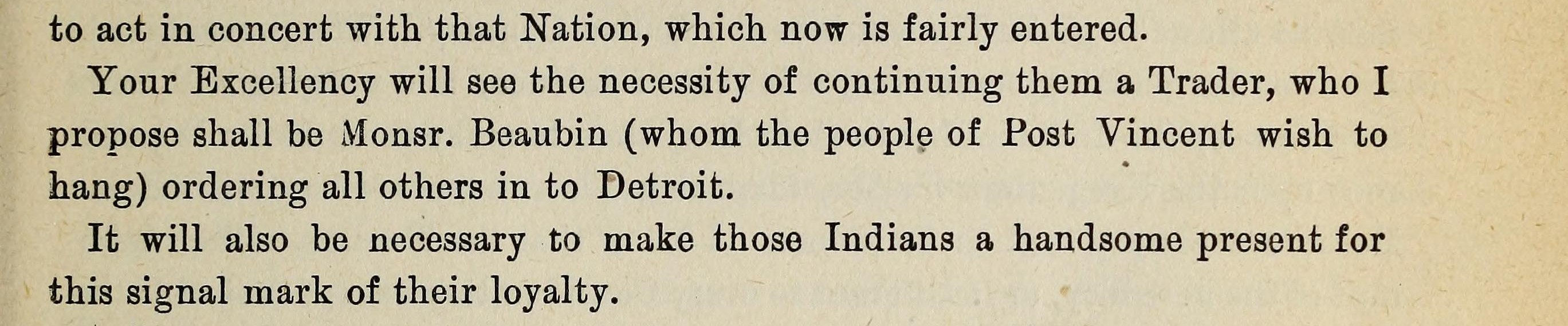
Your Excellency will see the necessity of continuing them a Trader, who I propose shall be Monsr. Beaubin (whom the people of Post Vincent wish to hang) ordering all others in to Detroit.
Every other trader called in, one man left. Major De Peyster adds a postscript almost as an afterthought: he forgot to observe that the Indians retook great part of the goods, and lodged them in Monsieur Beaubin's store again. The plunder went back on his shelves.
The Governor of Canada answered in January, and he was blunt about why the man was useful.
I approve much of your permitting Monsr. Beaubin to remain amongst them, his allowable resentment against the people of Post Vincennes and the benefit he will derive from his present situation, under the King's Protection, may if he is clever, be turned to good account, authentic and speedy Intelligence is what you have most to wish for
A grudge, noted in Quebec and costed. Frederick Haldimand is not describing a shopkeeper. He is describing an asset kept in place at a portage, because a man who wants revenge on Vincennes sends word faster than a man who does not.
That is why one building at the forks was worth a four-day ride with a hundred and three men. It was the Crown's only licensed store on that ground, its keeper wrote the nation's speeches and kept its accounts, he had led men against Vincennes, and the French there wanted him hanged.
The documents stop there, and it matters where.
Nothing in the British papers says Beaubien raised the party that destroyed the colonel. De Peyster gives the Miami their own account: the few then at the village were surrounded and did not dare stir till the enemy retreated, at which lucky period war parties arrived, which gave them heart and strength to follow them. No organiser is named, and no chief.
The county's histories name one. Wallace Brice, in 1868, says two traders nettled by the plunder incited the Indians to follow, and says plainly on an earlier page where his material came from, which was old men remembering. That is honest.
B. J. Griswold, in 1917, did the work. He gave Beaubien a titled section of his own, quoted Haldimand, quoted DePeyster's dispatch and its postscript, and found a 1780 letter of Richard Winston's calling him the general partisan at Miamis. On the attack he wrote two sentences, a page apart. The first hedges:
Charles Beaubien, the chief trader at Miami Town, who seems to have been the chief anti-American agitator of the region
The second, the first line of the next page, does not:
directed by Beaubien, resulted in the choice of Little Turtle to plan and execute the attack on the camp of the invaders.
A council directed by Beaubien, a chief chosen at it, and no source, on a page where he footnotes his numbers. The letter he does document says the colonel meant to take Beaubien. It does not say Beaubien answered.
The record stops short of the fire where the answer was made.
Sources
- Michigan Historical Collections, volume 19, 1892. Internet Archive. The Haldimand Papers. Captain A. Thompson to Major Arent S. De Peyster, Miamis 14 March 1781, on Beaubien's accounts and on the Indian speeches, printed pages 598 to 600, scan leaves n611 to n613; a translation of the memorandum captured with La Balme's papers, headed Intelligence concerning Detroit, with the two stores at the Miamis, printed page 587, scan leaf n600
- Michigan Historical Collections, volume 10, 1886. Internet Archive. The Haldimand Papers. Major De Peyster to General Haldimand, Detroit 16 November 1780, proposing Beaubien as the trader to be continued, the Miami account of the attack, and the postscript on the goods lodged in his store again, printed pages 448 and 449, scan leaves n467 and n468
- Michigan Historical Collections, volume 9, 1886. Internet Archive. The Haldimand Papers. Lieutenant Governor Henry Hamilton to General Haldimand, Detroit 16 September 1778, Beaubien employed for His Majesty at the Miamis and the war party of 6 September, printed page 475, scan leaf n490; General Haldimand to Major De Peyster, Quebec 6 January 1781, approving that Beaubien remain, printed page 641, scan leaf n656
- The Pictorial History of Fort Wayne, Indiana, 1917. Internet Archive. Volume 1. Beaubien as the chief trader who seems to have been the chief anti-American agitator, printed page 77, scan leaf n84; the council directed by Beaubien, printed page 78, scan leaf n85; the section headed Beaubien, the anti-American partisan, printed page 79, scan leaf n86
- History of Fort Wayne, 1868. Internet Archive. Wallace A. Brice on the two traders who incited the Indians to follow, printed page 105, scan leaf n132, and on his own sources, printed page 104, scan leaf n131
The text was read from scanned images. Every quotation was checked against the page image.
More from Fort Wayne
Fort Wayne
Without any provocation
A private pleaded guilty to rioting in the public cornfield. Three men were then sworn, and what they said was not about the riot. The commanding officer punished the other man too, without charging him.