Fort Wayne
A rascally scrambling trade
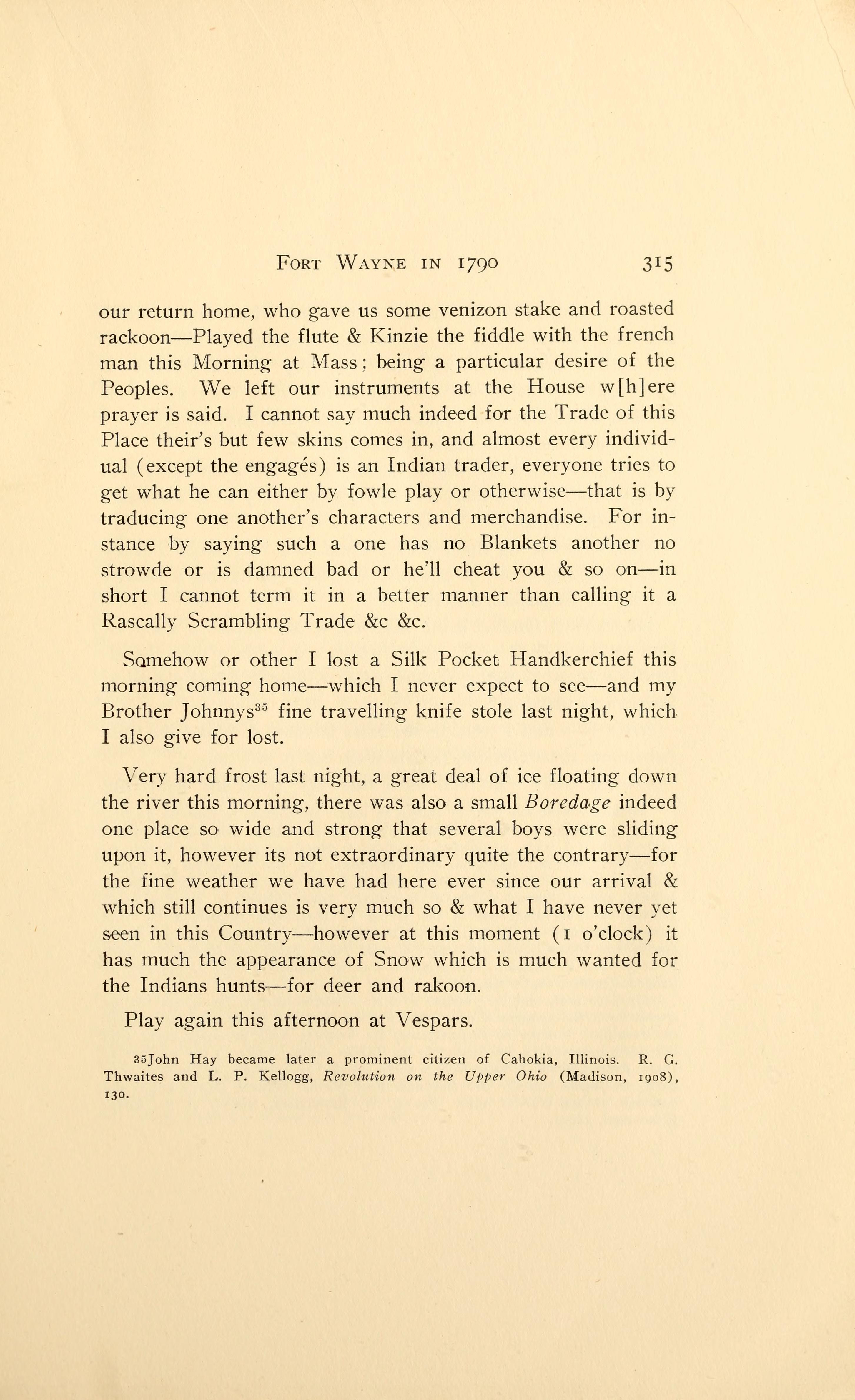
On Christmas morning 1789 Henry Hay took his flute to mass at the Miami town. John Kinzie brought his fiddle. The two of them played with a Frenchman in the house where prayers were said, and Hay wrote it down that day: "Played the flute & Kinzie the fiddle with the french man this Morning at Mass; being a particular desire of the Peoples." They played again "at Vespars."
He was a young man from Detroit, there from 16 December to the start of April, and his journal never says what he came to do. On the same Christmas page he described the traders he lived among. Almost everyone in the place was an Indian trader, he wrote, and each one ran down the others' goods: "such a one has no Blankets another no strowde or is damned bad or he'll cheat you & so on." He could not term it better, he said, "than calling it a Rascally Scrambling Trade &c &c."
What remains is a winter. There were two villages at the place, Hay wrote, one on each side of the river. The near one belonged to Le Gris. The other belonged to Pacanne, who was in Illinois, and in his absence it was commanded by "his nephew one Mr. Jean Baptist Richerville," a young trader so bashful that his mother spoke for him in council. Hay's journal makes Richardville Pacanne's nephew. A footnote Quaife added in 1921 makes his mother, Marie Louisa, the youngest sister of Little Turtle. The journal and the note do not agree.
On New Year's morning the Miami families came in "by three o'clock this morning," and one woman came to shake Hay's hand while he was still in bed. He went round the principal French households and "kissed all the Ladies young and Old."
The captives came in through the same weeks, and Hay wrote them into the same book.
On 18 December a prisoner was brought in, an Irishman from the County of Tipperary, "Aged about upwards of Forty," who had lost his father and mother young. Delawares had taken him near the Little Miami. He was to live with the traders through the winter as a servant, and "in the Spring the Indians have promised to take him safe back." Hay never gives his name. The journal does not say whether he went home.
On 20 December Hay learned that an elderly, tall American, taken by Little Turtle's war party, had been killed soon after his capture by one of the party, "in consequence he said of having some of his own relations killed lately." His captor tried to stop it and could not.
The same week Mrs. Adhemar, his hostess, offered to have his linen washed by the Pani woman she held as a slave. Hay does not name her.
On 13 February Shawnee warriors brought in a young man taken on the Ohio at the mouth of the Kentucky. The previous spring, Hay was told, Americans had fallen on a Shawnee hunting camp and "killed several of them women & Children &c." Among the dead was "one Joseph Sovereigns who had been a Prisoner from his infancy." The party had gone out to take a man near the same place. Hay feared "they would burn him." The chief sent word that he should not be hurt, and a belt of wampum was being made to put over his head when he was adopted. "He's quite a young man, his name is McMullen." He came from Richmond, Virginia. The adoption waited on the chief's return, and the journal never records it.
In late February the river flooded the village. George Ironside fell out of a canoe in the current, and Hay held to the graveyard pickets while the lads went after him. Ironside said afterward that when they reached him "he was just gone."
On 21 March a Shawnee party came in with three prisoners and a Black man. Nineteen people had been taken near Limestone. One of the prisoners was John Witherington. "This John Witherington's family is separated from him, he has a wife 7 months gone with childe & 7 children, which some of the other Parties have got Prisoners." Nothing more about them survives in the journal.
Three days later another of the nineteen, John Thompson, told Hay that Arthur St. Clair meant to call the tribes to a council at Vincennes, "But if the Indians do not come to a settlement with them, they mean to fight them." The next line is torn. Four leaves are missing after it.
What survives of the journal is an editor's printing of a copy, with pages missing and the ending gone. When the text resumes Hay is leaving. He called on everyone in the place, dined with the Adhemars, and settled with Marie Louisa for a horse she was to buy and send to him by her son. He left a little after noon, and the Adhemars told him "that I was much regretted by every one in the village."
Sources
- Fort Wayne in 1790: the journal of Henry Hay, 1921. Internet Archive. Henry Hay's journal as printed by M. M. Quaife, Indiana Historical Society Publications, volume 7, number 7. Scan leaves n8, n17 to n19, n22 to n24, n29 to n30, n53 to n55, n60, n67 to n69
- Chicago and the Old Northwest, M. M. Quaife, 1913. Internet Archive. Page 145, note 349, scan leaf n168; page 444, scan leaf n479
The text was read from scanned images. Every quotation was checked against the page image.
More from Fort Wayne
Fort Wayne
A total loss to the Seminary Fund
The county's first school was meant to be paid for by the fines of its courts. In 1841 the clerk counted $3,392.70 in fines and forfeitures since 1824, and $238.31 collected. In 1860 one of the seminary's lots was forfeited back to the fund.