Forfeited her bail of ten dollars
Published .
Eight people came before the mayor of Fort Wayne on the morning of Saturday 16 October 1880, and the Sentinel printed all eight names in a row. Two men were plain drunks and were taxed eight dollars each. Three more were taxed ten dollars each for being inmates of a dive on Nichols. One man's case, for exposing himself to women and little girls in the street, was put over for witnesses.
Between them, one line.
Julia Miller, for wandering around the streets, forfeited her bail of $10.
That is the whole of what the record gives about her. Forfeiting bail usually means the person did not come, and the paper does not say whether she did. It does not say what happened to her afterwards. The issues of the 20th, 21st, 22nd and 23rd were searched and her name is in none of them.
The eighth name on the list was the reason the court room filled up.
Ricardo O'Sullivan Burke was charged with having designedly associated with a common prostitute, Julia Miller. He pleaded not guilty and the trial commenced, the city having at noon introduced nearly all its evidence.
His case ran four days. Hers took one sentence.
By the Monday he had a headline of his own, with his rank in quotation marks.
"COL." BOURKE. Continuation of His Trial This Afternoon.
Police court-room was crowded this afternoon, the attraction seeming to exist in the fact that one "Col." Bourke was on trial for alleged association with prostitutes.
Mayor Zollinger took his seat shortly after a quarter past two, and Patrolman Frank Rohle was recalled and examined about the lights in the room where Bourke and the woman had been seen. By Tuesday morning the argument was under way at half past ten, and it lasted an hour. There were two lawyers. City Prosecutor Colerick put the charge as associating, knowingly and designedly, with a woman of bad repute, and said there were two points in it: whether he knew what she was, and whether he had a design.
Then he read out the law.
Mr. Colerick then read the ordinance on which the charge was made, and stated that it is made unlawful to be in the company of a prostitute.
That is the prosecutor's account of the ordinance, printed by a reporter. The ordinance itself is not in the paper. Irvin Stratton, for the defence, immediately disputed the reading and put a different test: that the offence needed three things together, proof at the time that the person was a common prostitute, the defendant knowing it, and his associating with that knowledge and a design. Two lawyers, two readings, and not one word of the text they were arguing about.
What the paper does give in full is how they talked about her. Colerick said the Colonel admitted being in her company half a dozen times for the purpose of drinking wine, and that this put him in an humiliating position, for we remember that it is through the wine cup that so many women have fallen. He said the Colonel claimed he had been imposed upon and thought he had a virtuous maiden, and then that he looked out of the window before leaving with her to see if the coast was clear. Stratton said the arrest was the instigation of malice and called it a dirty, mean insinuation conjured up by somebody hiding behind a policeman's star.
Colerick had the better line and used it.
In reply Mr. Colerick said he would rather be the officer behind his star of office, than the great and good "colonel" hiding behind the petticoats of Julia Miller.
He went one further, and asked whether, if the men who swore to Julia Miller's reputation were loafers, the colonel was not himself a vagrant under the same city ordinance. It was an argument about who counted as respectable, made by the man prosecuting, and it did not work.
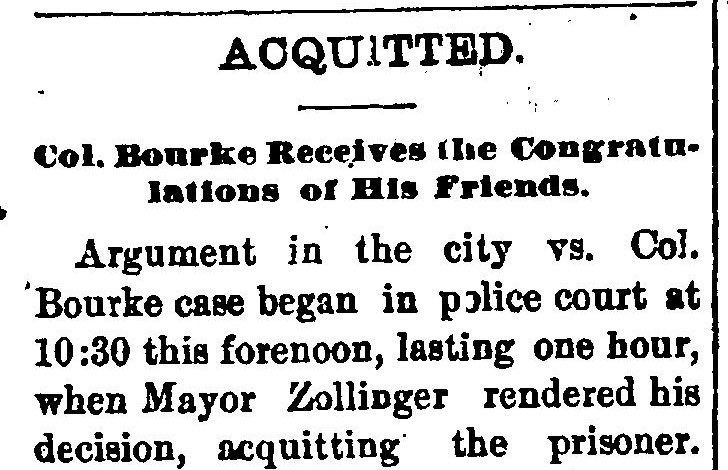
The testimony was reviewed at some length, presented to the court, and the defendant acquitted.
The headline over all of it reads ACQUITTED, and under that, in smaller type: Col. Bourke Receives the Congratulations of His Friends.
The words in the record are the charge's words, the prosecutor's words and the defence's words, and the headline over the Saturday list called the whole morning's business bawds and bums. What the record actually establishes about Julia Miller is one charge, wandering around the streets, and one outcome, ten dollars gone. Everything else said about her in those columns was said by men arguing about a man.
Four days, two lawyers, a crowded court, an acquittal and a line about congratulations. One sentence, ten dollars, and nothing after.
Sources
- Fort Wayne Sentinel, 16 October 1880, 1880. Internet Archive. The police court column headed Bawds and Bums, carrying the eight names, the fines, the line on Julia Miller and the charge against Ricardo O'Sullivan Burke, page 1, scan leaf n0
- Fort Wayne Sentinel, 18 October 1880, 1880. Internet Archive. The column headed "Col." Bourke, Continuation of His Trial This Afternoon, carrying the crowded court room and the recall of Patrolman Frank Rohle, page 1, scan leaf n0
- Fort Wayne Sentinel, 19 October 1880, 1880. Internet Archive. The column headed Acquitted, Col. Bourke Receives the Congratulations of His Friends, carrying both arguments, the prosecutor's reply and the verdict, page 1, scan leaf n0
The text was read from scanned images. Every quotation was checked against the page image. The paper spells the name Burke on the 16th and Bourke on the 18th and the 19th; both spellings are its own and both stand here as printed.
More from Fort Wayne
Fort Wayne
Boiling down their ashes to black salts
In November 1843 a man named Miller began building an ashery in Fort Wayne, and several farmers had bought kettles to boil their ashes down to black salts. In 1845 Miller wanted a hundred tons. In 1854 the last call for black salts ran three weeks.