Fort Wayne
Gave it the name of Fort Wayne
Published .
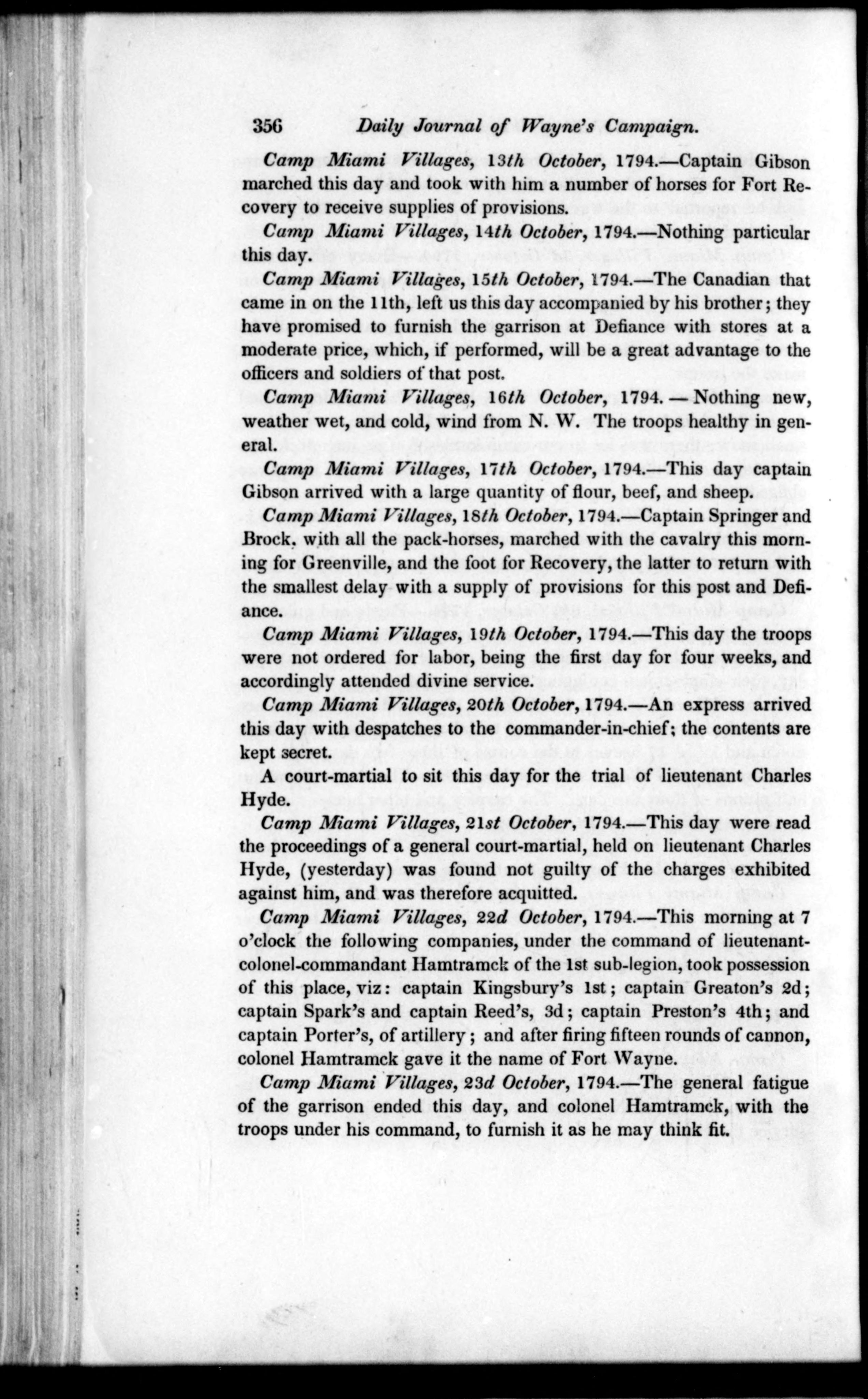
On the morning of 22 October 1794, after a night cold enough to freeze the ground hard, Lieutenant Colonel Hamtramck marched six companies of the Legion into a new log fort at the Miami villages.
General Anthony Wayne had given the order the day before. The detachment "will take Post in the Fort Tomorrow Morning at 7 OClock, under the Command of Lieut. Colo'l Commandant Hamtramck," it ran, and it listed the companies: Porter's artillery, Kingsbury's of the 1st sub-legion, Greaton's of the 2d, Sparks's and Reed's of the 3d, Preston's of the 4th. The general fatigue was to end that day. The fort was not finished, and the order said so: "The fortifications are to be completed by the above Detachment." The order said nothing about a name.
An officer who kept a daily journal of the campaign wrote down what happened in the morning. "This morning at 7 o'clock the following companies, under the command of lieutenant-colonel-commandant Hamtramck of the 1st sub-legion, took possession of this place," he wrote, and named the same six captains, "and after firing fifteen rounds of cannon, colonel Hamtramck gave it the name of Fort Wayne."
Lieutenant William Clark was there too, and kept his own journal in his own spelling. "A very cold night last frased hard. Col. Hamtramck took charge of the fort, after nameing it after his Excellency fireing 15 rounds & giving 3 chears, Marched in the Detachment." Then Clark added that he had dined with the commander in chief "by his perticular Invertation," and that he had heard the letter of Mr. Jay's embassy read.
So two officers who stood there put the name in Hamtramck's mouth. A third, General Thomas Posey, is known on the point only through a line an editor copied out of his manuscript in 1914: Wayne "requested the oldest officer in command to give a name to the Fort." Whose idea the name was, beyond that, the record does not say. Nobody at the Miami villages that morning wrote down who fired the fifteen rounds, or why fifteen.
In 1880 the compilers of a history of Allen County had that journal in front of them. They quoted it day by day through the autumn of 1794: the deserters from the British camp, the keg of whisky bought for eight dollars, the frost that left ice three quarters of an inch thick in the camp kettles, the court-martial of Lieutenant Charles Hyde. They quoted 21 October, when Hyde was acquitted, and closed the quotation marks.
Then they wrote 22 October themselves.
"On the morning of the following day, October 22, 1794, the new fort having been fully completed and ready for occupancy, passed the ordeal of a formal dedication to the god of war, with the usual ceremonies. Gen. Wayne then invested Lieut. Col. John F. Hamtramck with the command of the Post."
The fifteen rounds became "a final salute of fifteen rounds of artillery," and a flag went up that no officer at the fort had mentioned: "the Stars and Stripes were flung to the breeze, thereafter to float over the ramparts, indicative of the invincible character of the works as manifested in the appropriate and significant name of Fort Wayne."
What the history added was Wayne, the ceremony, the flag, and a fort "fully completed" on a morning when Wayne's own order had left the finishing to the men marching in. What it left out was the one clause both diarists agreed on. In the 1880 version Hamtramck receives a command and places his officers. He does not name anything. The name is simply manifested, and nobody gives it.
The histories that came after went back to the journal's sentence, and to Hamtramck.
The next day Clark had a different matter to record. "A Genl. order for giving out Shoes that is much wanted the men being nearly Barfooted, a few prs. only was isd. there being but a few prs. on hand."
Sources
- Michigan Pioneer and Historical Collections, volume 34, 1904. Internet Archive. Wayne's orderly book, 21 October 1794, page 560, scan leaf n592
- The American Pioneer, September 1842, 1842. Internet Archive. "Daily Journal of Wayne's Campaign", printed without an author's name, page 315, scan leaf n16; the note on missing leaves, page 317, scan leaf n18
- The American Pioneer, October 1842, 1842. Internet Archive. The entry for 22 October, page 356, scan leaf n17; the letter of 5 July 1842, page 357, scan leaf n18
- Journal of Wayne's Campaign, 1866. Internet Archive. The 1866 Cincinnati edition, printed for William Dodge by Jno. F. Uhlhorn, scan leaves n28 and n29
- Mississippi Valley Historical Review, volume 1, number 3, 1914. Internet Archive. William Clark's journal, edited by R. C. McGrane, page 444, with note 74 quoting Thomas Posey, scan leaf n103
- History of Allen County, Indiana, Kingman Brothers, 1880. Internet Archive. Printed page 36, scan leaf n41
The text was read from scanned images. Every quotation was checked against the page image.
More from Fort Wayne
Fort Wayne
A total loss to the Seminary Fund
The county's first school was meant to be paid for by the fines of its courts. In 1841 the clerk counted $3,392.70 in fines and forfeitures since 1824, and $238.31 collected. In 1860 one of the seminary's lots was forfeited back to the fund.