Fort Wayne
He was in the engagement
Published .
In the autumn of 1842, an old soldier at Honey Creek, in Miami County, Ohio, took out a journal he had kept for fifty-two years.
David Hamilton Morris had been first sergeant in Captain Joseph Ashton's company in 1790, when General Josiah Harmar marched an army north to the Miami towns at the head of the Maumee. Colonel McMaken of Fort Wayne had asked him to write out what happened there. He copied his sketch from the journal and signed it on October 8, 1842.
The Fort Wayne Sentinel printed it on March 4, 1843.
Morris tells it plainly. Around midnight on October 21, a scout came into camp and reported that about 120 Indians had collected in the bend opposite Fort Wayne. A detachment of regulars and Kentucky militia was sent back for them. Morris puts that detachment under Harden's command; Denny puts it under Wyllys. Between daylight and sunrise they reached the ford of the Maumee.
As the first men entered the river, the Indians opened fire. Major Fountain got up the far bank ahead of his troops, saw the main body waiting in ambush, and ordered a halt. At that moment, Morris wrote, he was shot dead.
The detachment was beaten. Its commander, Major Wyllys, was killed with it. Ebenezer Denny, the army's acting adjutant, was in camp eight miles away. The first news reached him when one of Fontaine's men escaped and came in "about eleven o'clock, A. M." Denny counted forty-eight federal soldiers and two officers lost that day.
Denny never calls the place a ford. He never names any Miami who fought there.
Morris does. One paragraph of his sketch reads:
Richardville a Miami Chief, now dead was in the engagement, and related that the, river run blood, and that he could cross the river on the dead bodies.
Jean Baptiste de Richardville had died in 1841, as principal chief of the Miami. The Sentinel's editor added his own line above the sketch. The account agreed, he wrote, with "the statements we have heard from the late Chief Richardville and other old residents of this place."
The page does not show whether the sentence about Richardville is Morris's or the editor's. It sits inside Morris's signed text, in the same type, unmarked.
Twenty-five years later, the story changed.
In 1868, Wallace Brice published the first history of Fort Wayne. His Richardville remembers the battle vividly. But in Brice he is watching it.
"At the time of Harmar's movements and defeat at this point, he was a boy of some ten or twelve years of age."
Brice's boy watches the warriors creep along the bank. No man is to fire until the soldiers have gained the stream and are about to cross. Then the rifles open, and horses and riders fall together until "the water ran dark with the blood of the slain."
Brice names no source except "early settlers here."
In 1889 a county historian reprinted the same passage, nearly word for word. He fixed Brice's grammar and kept the boy.
Two pages earlier, he says Richardville was born about 1761.
A man born in 1761 was twenty-nine at the ford. He does not notice.
Neither history gives his age in any way that can be checked. A man who met him that year does.
Henry Hay, a trader from British Detroit, spent the winter of 1789 at the Miami town. On December 23, ten months before Harmar came, he wrote in his journal that Pacanne, the chief of one of the two villages, was away in Illinois, and that "in his absence" the village was "Commanded by his nephew one Mr. Jean Baptist Richerville."
"This young man is a Trader here," Hay added. His father in Canada had written for him to come home. He meant to go in the spring.
A man running a village and a trading business is not a boy of ten or twelve.
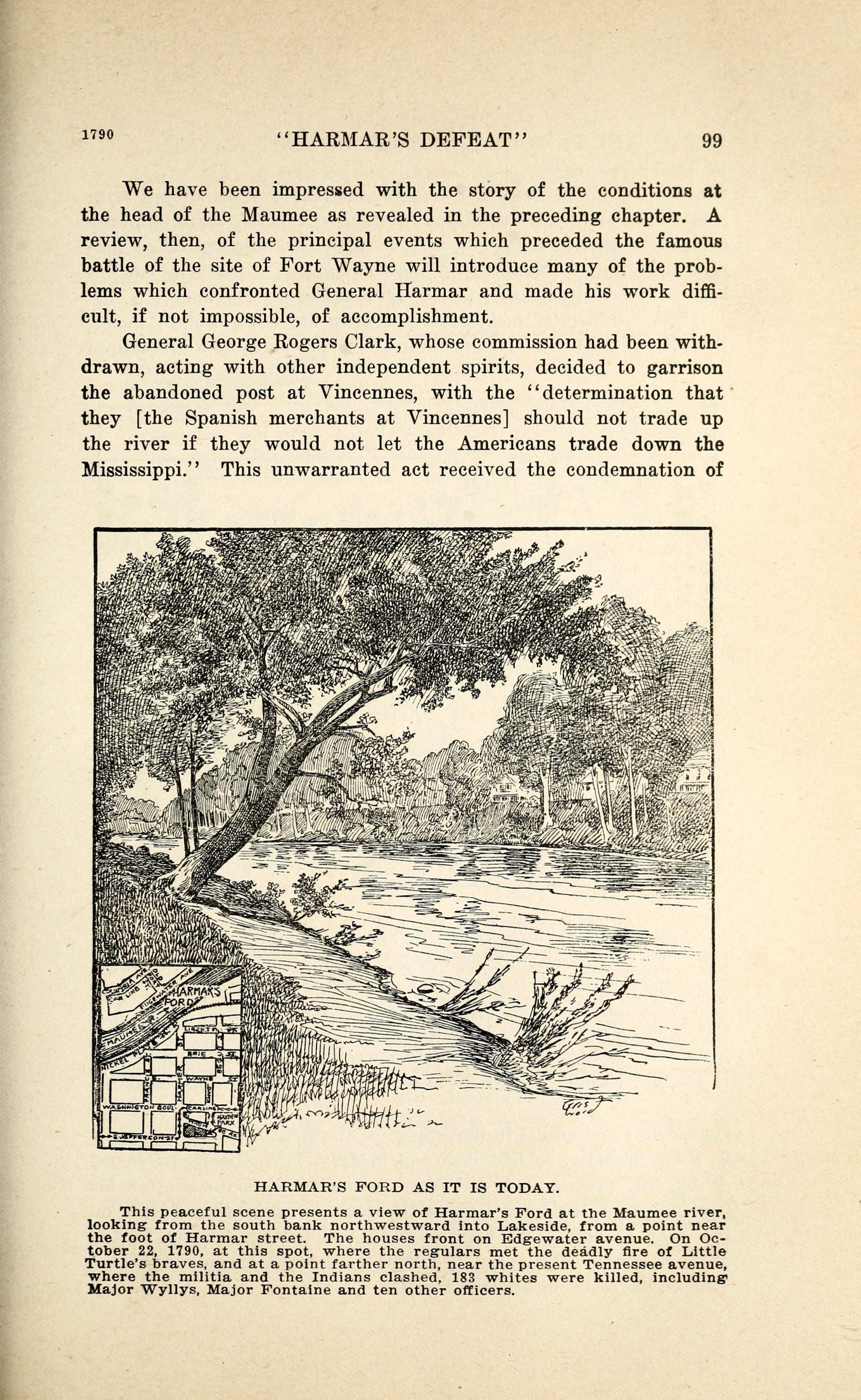
The ford has one more record. A note printed beneath Morris's sketch in 1843 placed "Harmer's Ford" near "the residence of F. Comparett, Esq., just below Fort Wayne." In 1868, Brice wrote that the indentations on either bank, just below a Comparet house, still showed a stranger where the ford had been. In 1917, B. J. Griswold printed a drawing of the spot, looking from the south bank at the foot of Harmar Street across into Lakeside.
Richardville's own words about that morning are in none of these accounts. The first account comes through an editor who had heard Richardville and others. The second comes through "early settlers here."
Only the first puts him in the river.
Sources
- Fort Wayne Sentinel, 4 March 1843: A Sketch of General Harmer's Campaign in 1790, David Hamilton Morris, first sergeant in Captain Joseph Ashton's company, 1843. Internet Archive. Scan leaf n3, columns four and five. Morris signed the sketch at Honey Creek, Miami County, Ohio, on 8 October 1842, and copied it from a journal he had kept since the campaign
- Military Journal of Major Ebenezer Denny, Ebenezer Denny, acting adjutant on the campaign, 1859. Internet Archive. Printed pages 147 and 148, scan leaves n170 and n171
- History of Fort Wayne, Wallace A. Brice, 1868. Internet Archive. Printed pages 129, 287 and 315, scan leaves n156, n318 and n346
- Valley of the Upper Maumee River, 1889. Internet Archive. Printed pages 33 and 35, scan leaves n32 and n34. The Richardville passage is Brice's, reprinted nearly word for word
- Fort Wayne in 1790: the journal of Henry Hay, Henry Hay, trader, of Detroit, 1921. Indiana Historical Society Publications. Internet Archive. Printed pages 313 and 314, scan leaves n22 and n23
- The Pictorial History of Fort Wayne, Indiana, B. J. Griswold, 1917. Internet Archive. Printed pages 48 and 99, scan leaves n55 and n106
Every quotation here was read off the page image rather than off the scanned text layer. Obvious scanning errors are corrected silently and no wording is changed. Where a page carries punctuation that looks wrong, as the 1843 Sentinel does in the paragraph about Richardville, it is reproduced as the page sets it.