If I go this is the way in which I shall present myself
Published .
He answered last, and he answered in red.
Messengers from the Ouiatanons had come up to the Miami town in February 1781 carrying a speech from the French at Post Vincennes and from the Piankeshaw, on four bunches of white wampum. White is the colour a man uses when he is offering something. The speech invited the Miami to come over, and it did not flatter them on the way.
You are all fools who listen to the English, who amuse us with the porcelain axes. As for ours it is so heavy that nothing can resist it, you will feel it then (throwing the strings to the earth) there is how I would treat those who will not be guided by the present speech
The English send words where he sends iron, and then he threw the words on the ground. A second string, also white, came in the name of thirty villages that are not named, addressed to the Miami, the Huron, the Sauteaux, the Ottawa, the Potawatomi, the Loups and everyone else on the King of England's side. Its message was a warning dressed as courtesy.
we would warn you to take good care of yourselves, to keep yourselves quiet not to alarm yourselves at our passage, we are so powerful that we look upon the men of the Lakes as nothing, not more than your father the English
A Miami chief the page does not name answered first, with a belt the commandant at Detroit had given them, and then with four strings of black wampum handed to the Potawatomi who were at the council.
Then Pacanne took the floor, and every object he put down was painted.
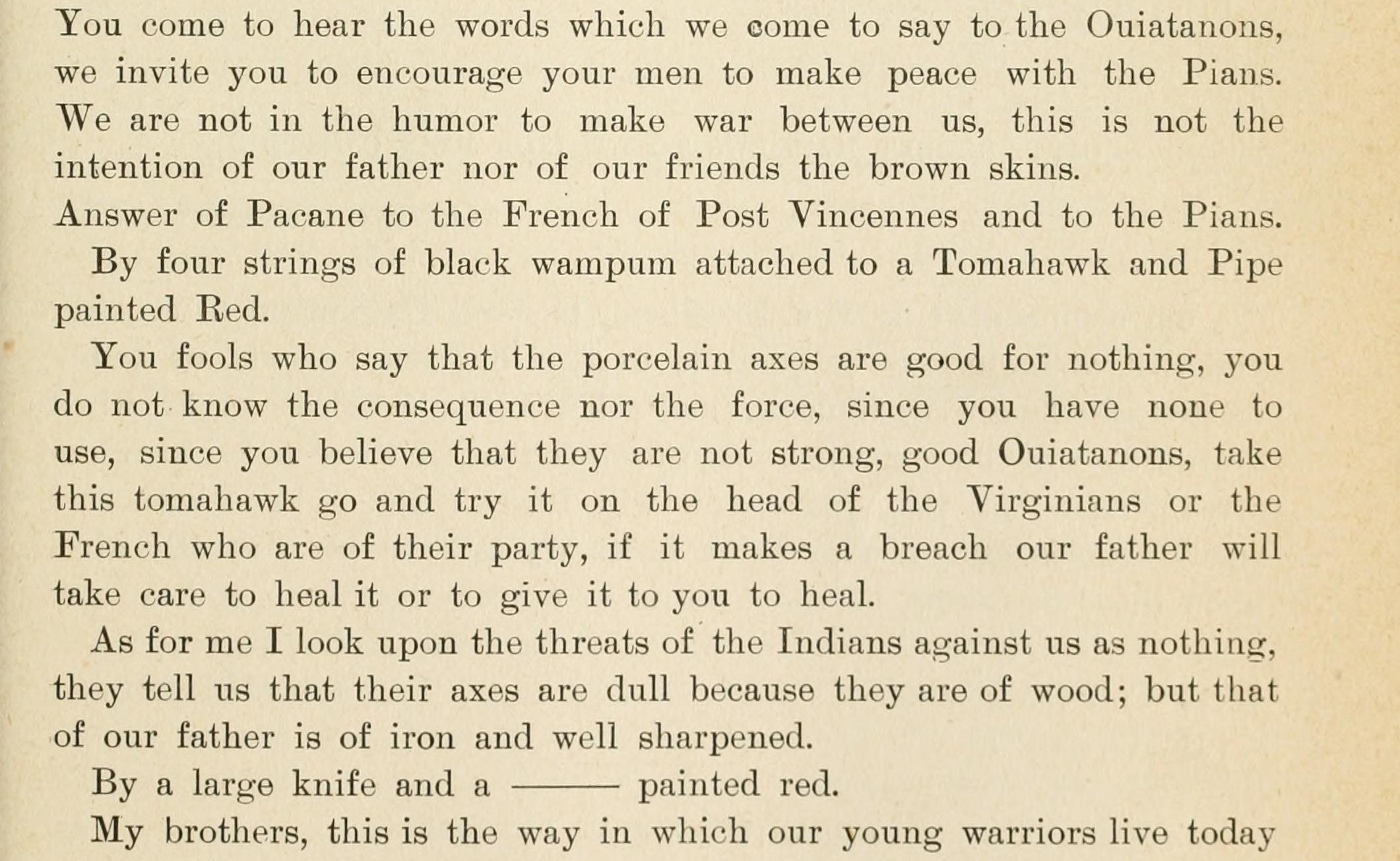
The first was four strings of black wampum tied to a tomahawk and a pipe painted red, and he told them what to do with it: take this tomahawk, go and try it on the head of the Virginians, or of the French who are of their party. The second the printed page cannot name. It reads "By a large knife and a", then a blank rule about as wide as a short word, then "painted red". The 1892 editor left the gap and said nothing about it, and so the object Pacanne held up in his hand is lost.
The third was a carrot of tobacco painted red, and here he made the colour itself the argument.
Good war Chiefs, there is a pipe of tobacco which I give you to smoke, if the colour is not repugnant: on the contrary it should encourage you and make you wrath against those who are the authors of all your miseries and all your misfortunes
He is daring them to object to it.
The fourth was a red cloth blanket, and with it he came to the thing that had been asked of him.
You see our village stained with blood, you can think that we are not going to extend the hand to your friends who are our enemies; you can understand that if we find you with them that we will not make any distinction. You say that I am wanted to go to Post Vincennes that I shall be well received, I should be entirely lost, if I go this is the way in which I shall present myself (he rose and sung the war song and many other Miamis have followed his example.
The bracket opens and never closes. The clerk had been writing Pacanne's own words in the first person for four pages, and at the moment the speech stops being words the clerk steps into the record to say what happened instead, and then the sentence simply ends. There is room on the line for a closing bracket. It is not there.
Under it, ranged right: A true copy. AT. S. DE PEYSTER. The commandant at Detroit certifies the copy and that is the last mark on the document.
It is also the only thing the page says about how the speech was made or where it went. The letters printed on the same leaf each carry an endorsement saying who wrote them, to whom, and where they were dated. This speech carries none. The page does not say what language Pacanne spoke, or what language it was taken down in, only that what is printed is a literal translation. It does not name who translated it. It does not say who carried it to Detroit, or who it was sent to when it arrived. Eight years earlier the same volume prints a Miami speech that carries every one of those things on its own page, down to the translator by name.
What reaches Detroit, and how, is visible once. Three weeks later the officer posted at the Miami town wrote to the same commandant.
You'll please receive a Speech from the French at Post St. Vincent, and thirty different Nations of Indians unknown, brought here by the Onias to the Miamis, Ottawas &c. &c. &c. and the answer to it from the Miamis
That is how a speech travelled, as an enclosure in an officer's mail. It is not this speech. Nothing on either page says so.
The printing gives his name two ways, two leaves apart. The heading of the speech brought to him calls him Lacane. The heading of his answer calls him Pacane.
Sources
- Michigan Historical Collections, volume 19, 1892. Internet Archive. The Haldimand Papers. The speeches of 25 February 1781, headed SPEECHES and marked Translation Literal, datelined Miamis: the speech brought from the French of Post Vincennes and the Piankishaws by the Ouiatanons, printed page 593, scan leaf n606; its second presentation and the answer of the unnamed Miamis Chief, printed page 594, scan leaf n607; the Answer of Pacane, its first presentation and the blank rule, printed page 595, scan leaf n608; the carrot of tobacco, the red cloth blanket, the war song and the attestation by Major Arent S. De Peyster, printed page 596, scan leaf n609, referenced B 101 p 10. Captain A. Thompson to Major De Peyster, datelined Miamis 14 March 1781, forwarding a speech from the French at Post St. Vincent and the answer from the Miamis, printed page 599, scan leaf n612
The text was read from scanned images. Every quotation was checked against the page image. The 1892 printing gives the speaker's name two ways, Lacane in the heading of the speech brought to him and Pacane in the heading of his answer; neither is corrected in the quotations here, and this archive writes Pacanne. The blank rule on printed page 595 is in that printing and is not an artefact of the scan.
More from Fort Wayne
Fort Wayne
More than they are either able or willing to bear
In June 1853 Fort Wayne had 1,200 school children and no public schoolhouse. The editor of the Sentinel wrote that a school tax might be more than the city could bear, and the voters turned it down, 325 to 130. Five years later he was elected a school trustee.