Fort Wayne
Late of Allen county, deceased
Published .
Word came to him that cattle had broken into one of his nurseries on the St. Joseph River. He was about fifteen miles away. He was old by then, and he went at once, and made the journey without stopping.
When he got there he was very much fatigued. He lay down that night and did not get up again. A fever settled on him, and in a day or two he was dead.
That is how a Richland County historian set it down, and for the burial he quoted a neighbour named Worth. "We buried him," Worth said, "in David Archer's graveyard, two and a half miles north of Fort Wayne."
The man was John Chapman, commonly known as Johnny Appleseed. The settlers who set out the first orchards in Cedar Creek and Lake townships had bought their trees and their seed from him.
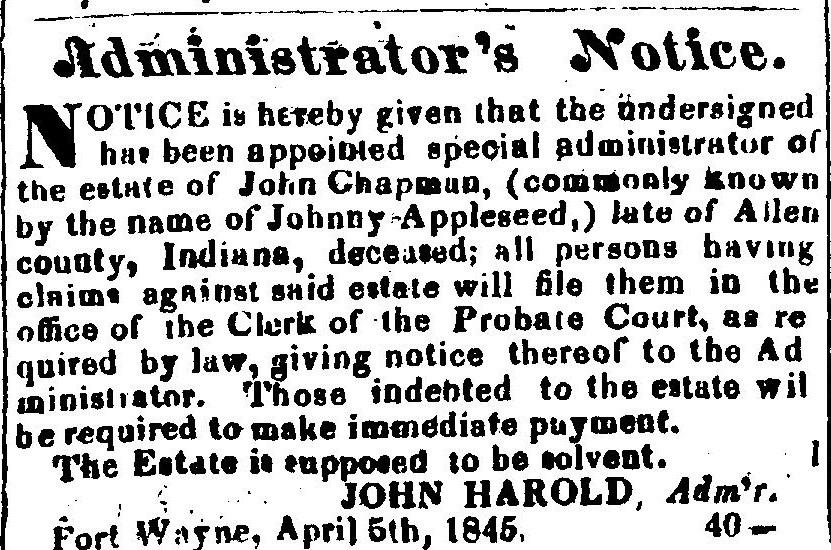
One record was written while his death was still news. It is a notice in the Fort Wayne Sentinel.
NOTICE is hereby given that the undersigned has been appointed special administrator of the estate of John Chapman, (commonly known by the name of Johnny Appleseed,) late of Allen county, Indiana, deceased; all persons having claims against said estate will file them in the office of the Clerk of the Probate Court, as required by law, giving notice thereof to the Administrator.
It was signed by John Harold and dated at Fort Wayne on 5 April 1845. The estate, the notice said, was supposed to be solvent.
It proves one thing. By 5 April 1845 he was dead, which makes 1847, about 1849 and 1864 impossible.
Those are three of the years historians later gave him.
Wallace Brice wrote the first history of Fort Wayne. He did not mention Chapman at all. Not the name Chapman, not the name Appleseed, not a nursery.
L. H. Newton, writing the township histories for the county, gave him a paragraph under Washington Township. "His nursery was at the farm now owned by Mr. Blakey," Newton wrote. "He died in 1864, at the house of Mr. Worth, with whom he boarded."
A county historian writing in 1889 called him Jonathan, and wrote: "His bones lie in a neglected and forgotten grave, where they were placed about forty years ago." Forty years before 1889 is about 1849.
B. J. Griswold settled on 1843. "The year 1843 brought to a close the life" of Johnnie Appleseed, he wrote, and on the next page: "He died on the 11th of March, 1843, at the home of William Worth."
In May 1916 a bronze tablet went up in Swinney Park, and Griswold printed its words. "Johnnie Appleseed (John Chapman), born in Massachusetts, 1776; died near Fort Wayne, 1843; buried in David Archer cemetery."
No year, then 1864, then about 1849, then 1843, and 1843 again in bronze.
Griswold also printed a witness. Under his drawing of the Archer burying ground he quoted John Archer, writing in 1900: "The historical account of his death and his burial by the Worths and their neighbors, the Pettits, the Goings, Porters, Notestines, Beckets, Parkers, Witesides, Pechons, Hatfields, Parrants, Ballards, Randsells and the Archers, in the Archer burial ground, is substantially correct." The caption above it says Chapman died in 1843.
Those words had been printed before, in Ohio, the year Archer wrote them. They came from a letter dated 4 October 1900 from John H. Archer, grandson of David Archer, and the editor who printed it, E. O. Randall, said which account the letter meant.
"John Chapman was buried at Ft. Wayne, Indiana, in the year 1847, according to the history of Richland county, by A. A. Graham." Archer's letter, Randall wrote, "states that the account in Mr. Graham's history is practically correct."
It was the story of the cattle and the nursery. Worth's words in it are about the burial. The year is the historian's own, and he put the death "in the spring of 1847."
So the account Archer called substantially correct was the story of a death in 1847. Griswold printed Archer's endorsement under 1843, and did not say what Archer had endorsed.
Randall gave a day as well. "He died at the home of William Worth in St. Joseph township, Allen county, Indiana, March 11, 1847." Graham gives no day. Griswold gives the 11th of March, 1843. Randall and Griswold agree on the day and not on the year.
Archer's letter did not stop where Griswold stopped it.
"The grave, more especially the common head-boards used in those days, have long since decayed and become entirely obliterated, and at this time I do not think that any person could with any degree of certainty come within fifty feet of pointing out the location of his grave."
Sixteen years later the tablet in Swinney Park named the cemetery, and gave the year as 1843.
Sources
- Fort Wayne Sentinel, 19 April 1845. Internet Archive. Scan leaf n2. Administrator's notice for the estate of John Chapman, signed John Harold, dated 5 April 1845
- History of Richland County, Ohio, A. A. Graham, 1880. Internet Archive. Printed pages 270 and 271, scan leaves n283 and n284. Worth's account of the death and burial
- History of Fort Wayne, Wallace A. Brice, 1868. Internet Archive
- History of Allen County, Indiana, Kingman Brothers, 1880. Internet Archive. Township chapters by L. H. Newton: Washington, printed page 178, scan leaf n314; Cedar Creek, page 147, leaf n219; Lake, page 155, leaf n245
- Valley of the Upper Maumee River, 1889. Internet Archive. Printed page 250, scan leaf n265
- Ohio Archaeological and Historical Publications, volume IX, 1900. Internet Archive. E. O. Randall, "Johnny Appleseed", printed pages 309 to 312, scan leaves n322 to n325, with John H. Archer's letter of 4 October 1900 in a footnote
- The Pictorial History of Fort Wayne, Indiana, B. J. Griswold, 1917. Internet Archive. Printed pages 370, 371 and 373, scan leaves n381, n382 and n384; the Swinney Park tablet, unveiled 5 May 1916, at scan leaf n579
The text was read from scanned images. Every quotation was checked against the page image.
More from Fort Wayne
Fort Wayne
Without any provocation
A private pleaded guilty to rioting in the public cornfield. Three men were then sworn, and what they said was not about the riot. The commanding officer punished the other man too, without charging him.