Beyond Allen County
Looked upon as Bastards
Published .
Baby walked into a council at Detroit on 28 August 1773 with several Huron chiefs and a speech that was not his own. He had carried it from the Miami town, where it had been spoken ten days earlier, and he handed it to the officer commanding the post.
What he was delivering was an answer. Sir William Johnson, superintendent of Indian affairs for the north, had sent the Miami a message, and he had not sent it directly. It went by way of the Huron, which is why the Huron were the ones standing in the council room reading it back.
The Miami begin politely enough. They are well pleased, they say; this is the first time they have had the pleasure of knowing that the General speaks to them at all. Then they explain why they have not heard him before.
we have always had bad birds fluttering about our heads, who vexed our hearts, so that we could hear nothing right We'll name you these birds they are the Shawanese: who at the same time they talked of peace, told us to keep our axes, always sharp, and ready so soon as the Tawny Ekins (meaning the Indians) were assembled
The Tawny Ekins is the clerk's gloss, set in the translation as a parenthesis, and it means the Indians. The birds were telling the Miami to be ready to strike every man who wore a hat.
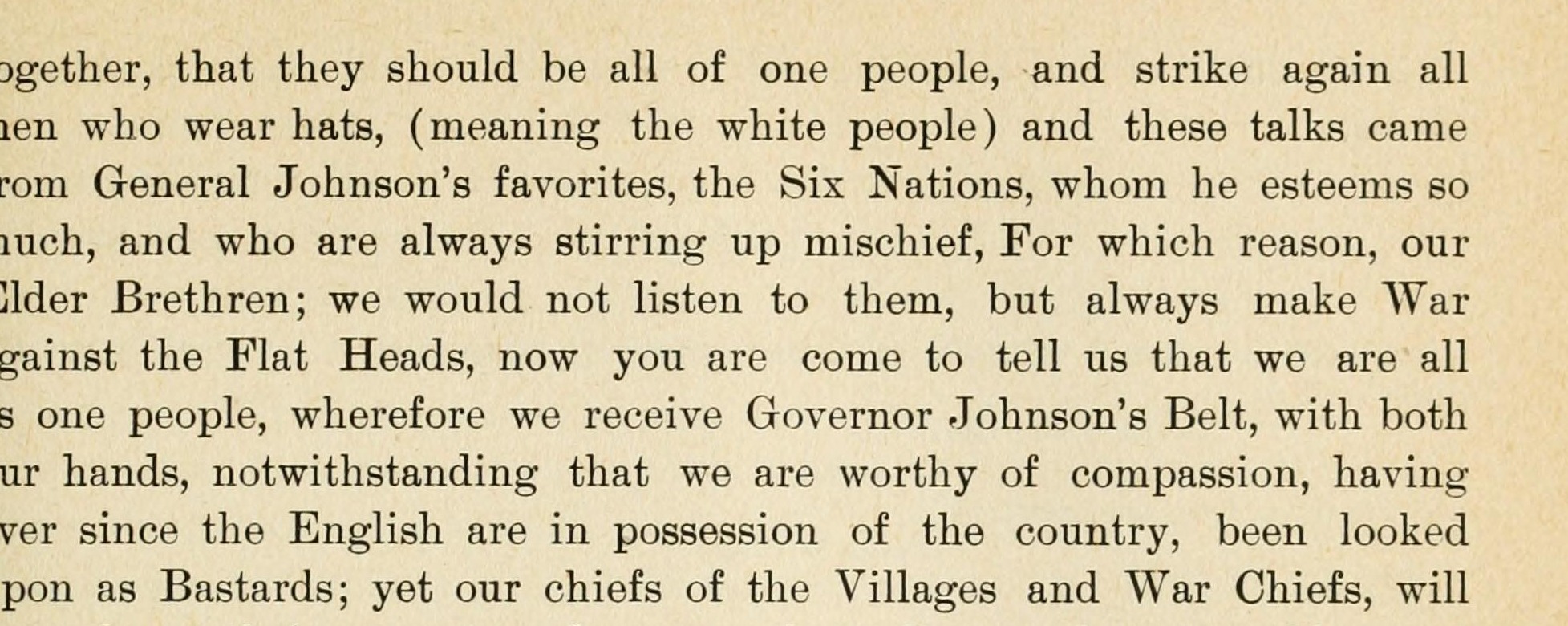
these talks came from General Johnson's favorites, the Six Nations, whom he esteems so much, and who are always stirring up mischief
They are telling the Superintendent of Indian Affairs, in a document his own side wrote down and filed, that the mischief comes from the nations he trusts most. Having said it, they accept his belt anyway, and they attach a condition to the acceptance that is not a condition at all but an account of what the last ten years have been like.
wherefore we receive Governor Johnson's Belt, with both our hands, notwithstanding that we are worthy of compassion, having ever since the English are in possession of the country, been looked upon as Bastards
The French had gone in 1763. This is 1773. That is what the change of flag had been worth, said in one word to the men who had made it.
Then they answer the reproach they had actually been sent. The Huron had told them the road was found stained with the blood of white people.
Tis true it is stained, but we have not stained it; The road was made by our Ancestors, it now turned aside; we are not the cause of it. Tis true we have imbrued our hands in the Blood of our Brethren, the White People; but it was not on the road of our ancestors, it was off from it, in the Enemies country our Tomahawk fell
It is not a denial. It is a boundary: the road their ancestors made is one thing and the enemy's country is another, and blood shed off the road is not blood shed on it. They name the case being held against them, a blow struck at Major Cochran, and say that if he had known the former road the matter would not have happened, because he was found in the path of the enemy. The old road, they finish, is open again, and they are going all together to sweep it and make it clean, so that every one may pass without molestation.
Most speeches in these papers arrive without a word about how they got there. This one does not. The speech says where it was spoken and when, Miamis, 18 August 1773. A note under the signatures says who carried it and where it arrived.
The preceeding Speech was delivered by Baby and several Huron chiefs in council at Detroit 28th August 1773 to Major Henry Basset Commander and translated from the French by James Stirling.
Spoken at one place, carried by named men, delivered at another place ten days later, to a named officer, out of French, by a named translator. And the next day the officer wrote to his own superior and confirmed it from his end, calling it the enclosed which he received from the Hurons in council, ready, wrote in French and translated by Mr. James Stirling for him.
In the same letter he explains why he needed Stirling.
I'm so uncomfortable as not to speak French, or understand it sufficiently without an Interpreter, hitherto I have been under an obligation to Mr. Stirling Mercht who has been ready on all occasions to attend, has wrote & answered all my French Letters without any gratuity
Stirling was a merchant. He was not paid for it. The commanding officer at Detroit, in a town whose inhabitants Basset puts at near thirteen hundred souls, could not read his own incoming mail without asking a shopkeeper for a favour, and he was writing to ask that somebody be appointed to do it properly.
So the Miami sentence about being looked on as Bastards survives because a Huron carried it, a merchant translated it for nothing, and a major who could not read French sent it on anyway.
Sources
- Michigan Historical Collections, volume 19, 1892. Internet Archive. The Haldimand Papers. Speech in Indian Council at Detroit, the answer of the Miamis Indians to Sir William Johnson's speech addressed to them by the Hurons, datelined Miamis 18 August 1773, printed pages 308 to 310, scan leaves n321 to n323, with the note of its delivery at Detroit on 28 August 1773 and its translation from the French by James Stirling, referenced B 70 p 188. Major Henry Basset to General Frederick Haldimand, Detroit 29 August 1773, enclosing it and asking that a French interpreter be appointed, printed page 310, scan leaf n323, referenced B 70 p 142
The text was read from scanned images. Every quotation was checked against the page image. The custody note is printed with the spelling preceeding and the quotation carries it.