Duplasy, Milliet, Cardinal, Joseph André
Published .
A French colonel rode out of Ouiatanon in the autumn of 1780 with a hundred and three mounted men and a set of rules he had written himself, about how his men were to behave on the march. They were four days on the road. They were going to one building: the storehouse of Charles Beaubien at the Miami town, where the St. Joseph and the St. Mary's meet.
He knew what was in it before he went. Among his papers was a memorandum, questions with answers written under them. What merchandise was at the Miami? A thousand pounds of powder, with lead in proportion, arms, blankets, cloth and shirts, about fifty thousand livres' worth, the whole in Beaubien's warehouse in the charge of Monsieur Lafountaine and an old man. Who were the inhabitants, and what were their characters? The answer named them one by one: Barthelemy, Rivard, Sevrance, Guoin, Lascelle, Pottervin, Paillet, Duplessy.
He took the goods and he waited. Twelve days, for men from Vincennes who never came. Then he withdrew with what he had.
What happened next was written down twice inside a month, by two men on opposite sides, and neither account was used by the county's historians.
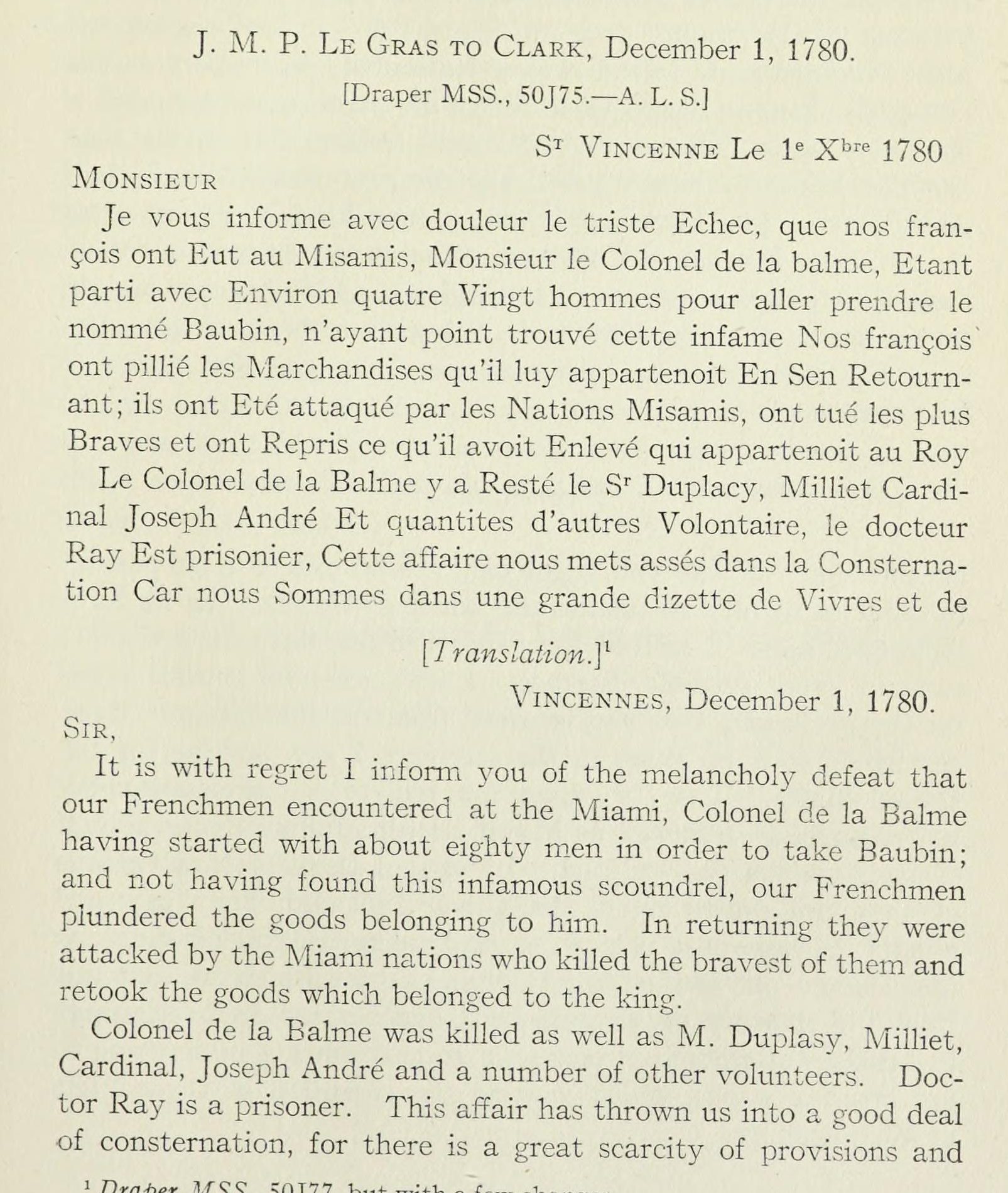
The first is a letter from Vincennes, dated 1 December 1780. J. M. P. Le Gras wrote to George Rogers Clark in French.
It is with regret I inform you of the melancholy defeat that our Frenchmen encountered at the Miami, Colonel de la Balme having started with about eighty men in order to take Baubin; and not having found this infamous scoundrel, our Frenchmen plundered the goods belonging to him. In returning they were attacked by the Miami nations who killed the bravest of them and retook the goods which belonged to the king.
Then he named the dead.
Colonel de la Balme was killed as well as M. Duplasy, Milliet, Cardinal, Joseph André and a number of other volunteers. Doctor Ray is a prisoner.
Four men and their colonel, named six weeks afterwards by somebody who knew them.
The second was written at Detroit two weeks earlier. Major Arent DePeyster commanded there for the British, and his report of 13 November is the earliest surviving account.
A detachment of Canadians from the Illinois and Post Vincent arrived there (at the Miami's town) about ten days ago, and entered the village, took the horses, destroyed the horned cattle, and plundered a store I allowed to be kept there for the convenience of the Indians, who soon after assembled and attacked the Canadians, led by a French colonel, whose commission I have the honor to enclose.
He counted cattle and horses, because the store was one he had licensed, and put the Miami dead at five. The Frenchman at Vincennes counted his own. Neither man names anyone who led the attack. Le Gras says the Miami nations. DePeyster says the Indians assembled.
The county's first history came eighty-eight years later, and its author said plainly what he had.
But of him and his expedition, it may be here stated, very little information of an entirely authentic shape, is within our reach. Excepting about a dozen lines in Mr. Dillon's Historical Notes, no published account whatever of this expedition has ever appeared. Whatever may be given in this brief sketch, has been obtained mostly from some of those who were in part eye-witnesses to the events, and from tradition as handed down by the old inhabitants.
That is honest practice. Wallace Brice said where he got it and what it was worth, and then he told the story his informants told him: that the colonel came up the Wabash with between fifty and sixty men, that he camped near the Aboite, that Beaubien and La Fontaine incited the Indians to follow, that the attack came in the night under their war chief, the Little Turtle, and that not one of the party is said to have survived to relate it. The night, the creek and the chief's name are his, from that tradition. The two men who wrote in 1780 give none of them.
What followed him was not honest practice. The county atlas of 1880 reprinted his paragraphs almost word for word, including his warning about how little was within reach. The history of 1889 condensed the same account. The pictorial history of 1917 gave it a chapter. Four books, one source, and the source had told them he worked from what old men remembered.
Le Gras's letter is not hidden. It was printed with a translation beside it in the George Rogers Clark papers, out of the Draper manuscripts at Madison. DePeyster's dispatch was quoted in 1909, in an article that also printed the colonel's marching rules and the papers taken with him.
Two names off those papers were still in the town nine years later, when Henry Hay wintered there. La Fontaine, who had charge of the warehouse when it was emptied, is in Hay's journal, five days on acorns coming home. Adhemar, whom the memorandum called a merchant and a dangerous man, is the host Hay visits most: coffee in the afternoon, a hop at his house without ceremony, a family he found decent and polite.
Duplasy, Milliet, Cardinal, Joseph André and Doctor Ray are in none of the four histories. Neither is Le Gras.
Sources
- George Rogers Clark Papers, 1771-1784, 1912. Internet Archive. Illinois Historical Collections volume 8. Le Gras to Clark, 1 December 1780, in French with the translation beside it, printed pages 469 and 470, scan leaf n656. The heading gives the original as Draper MSS., 50J75, an autograph letter signed, and the translation as 50J77
- Transactions of the Illinois State Historical Society for the year 1909, 1909. Internet Archive. C. M. Burton, "Augustin Motin de la Balme", from printed page 101. The march from Ouiatanon, the twelve days of waiting and DePeyster's dispatch of 13 November 1780, printed page 117, scan leaf n128. The captured memorandum, Appendix VI, printed page 132, scan leaf n143
- History of Fort Wayne, 1868. Internet Archive. Wallace A. Brice on his own sources, printed page 104, scan leaf n131; his account of the camp, the night attack and Little Turtle, printed page 105, scan leaf n132
- History of Allen County, Indiana, 1880. Internet Archive. Kingman Brothers. The La Balme passage, which reprints Brice almost word for word, scan leaves n32 and n33
- Valley of the Upper Maumee River, 1889. Internet Archive. Volume 1, the La Balme account condensed, printed pages 70 and 71, scan leaves n86 and n87
- The Pictorial History of Fort Wayne, Indiana, 1917. Internet Archive. Volume 1, chapter IX, "The Massacre of La Balme", from printed page 74
- Fort Wayne in 1790: the journal of Henry Hay, 1921. Internet Archive. Indiana Historical Society Publications volume 7 number 7, edited by M. M. Quaife. La Fontaine on acorns and the Adhemar household, scan leaves n22 to n29
The text was read from scanned images. Every quotation was checked against the page image. DePeyster's dispatch of 13 November 1780 is quoted as Clarence Burton printed it in 1909: the Michigan Pioneer and Historical Collections volumes that carry the Detroit correspondence are lending-locked, and the original has not been seen here.
More from Fort Wayne
Fort Wayne
Gave it the name of Fort Wayne
On 22 October 1794 Hamtramck marched six companies into the new fort, fired fifteen rounds and named it. Two officers who were there wrote that down. In 1880 a county history quoted one of them to the day before, then wrote its own 22 October.