Paid by the Indians themselves
Published .
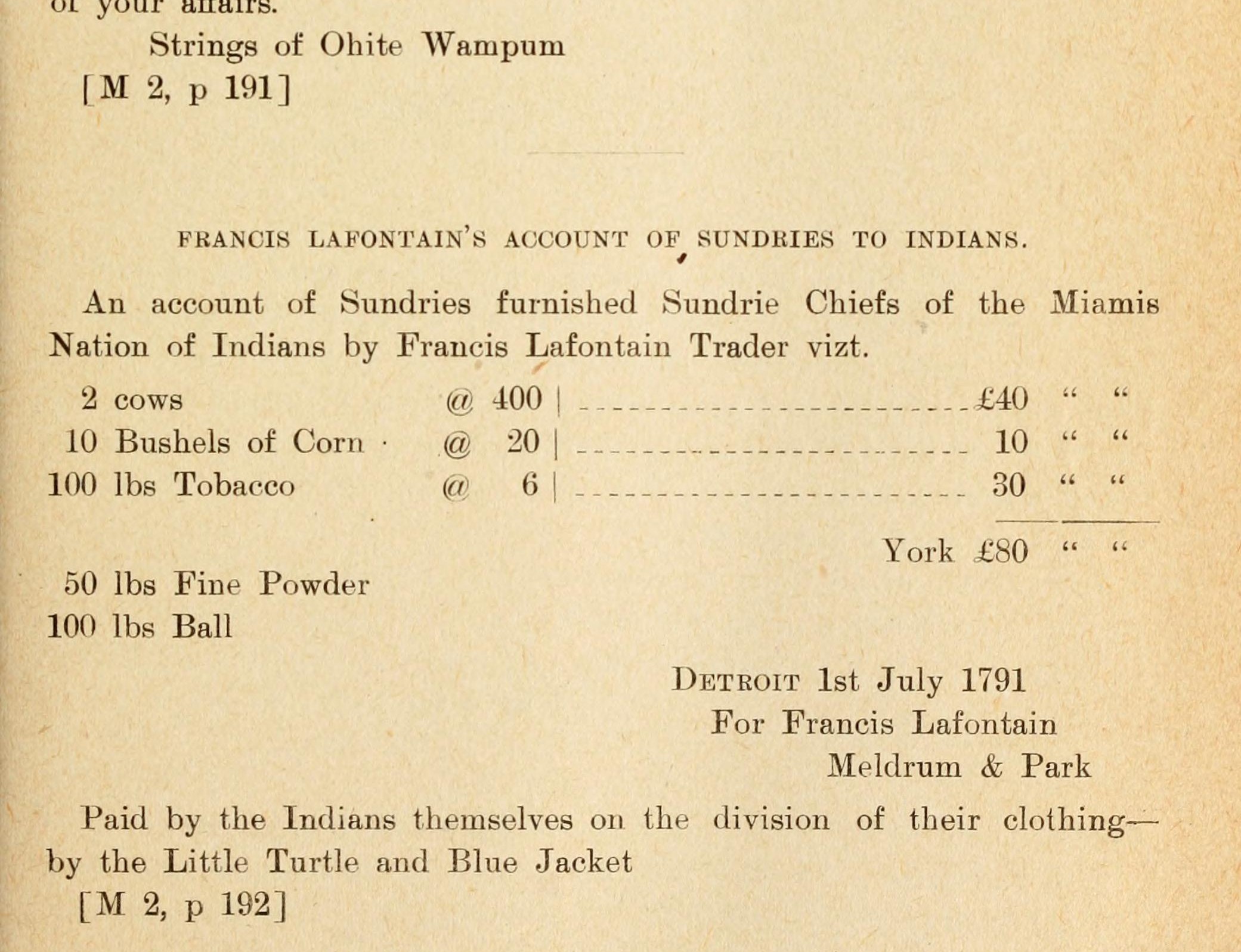
Somebody in a Detroit counting house ruled up a bill on 1 July 1791 and got the sum right. Two cows at four hundred, ten bushels of corn at twenty, a hundred pounds of tobacco at six. The extensions run down the right hand column, forty pounds, ten, thirty, and under a double rule the total: York, eighty pounds.
The heading says what it was for.
An account of Sundries furnished Sundrie Chiefs of the Miamis Nation of Indians by Francis Lafontain Trader vizt.
York means New York currency, the money of account at the upper posts. The figures beside the goods have no unit printed against them, but the arithmetic settles it and leaves no room: two cows at four hundred coming to forty pounds means twenty to the pound, and so does ten bushels at twenty coming to ten, and a hundred pounds of tobacco at six coming to thirty. Twenty shillings to the pound. So a cow was twenty pounds, a bushel of corn was one, and tobacco was six shillings a pound, in the New York money that Detroit merchants kept their books in.
Then, below the ruled total, outside the sum, two more lines with no price beside them at all.
50 lbs Fine Powder 100 lbs Ball
Powder, and twice the weight of lead to go with it, and the paper does not say what they cost or who paid for them.
The bill is signed at Detroit by a merchant house on the trader's behalf, For Francis Lafontain, Meldrum and Park. And then, flush left, in the clerk's own hand and not the trader's, comes the line that makes this one page worth reading.
Paid by the Indians themselves on the division of their clothing, by the Little Turtle and Blue Jacket
Themselves. A bill for goods furnished to Miami chiefs, drawn at Detroit, filed in the British Indian Department's papers, would ordinarily be a charge on the Crown. This one was not. It was settled out of the Indians' own share, at the moment that share was being handed over, and two men are named as having done it.
What that moment was is on the same leaf, just above. The document the bill follows is a speech, and its date is the same day.
Col. McKee's Speech to the following Nations of Indians, at the foot of the Miamis Rapids
Thirteen nations are listed in two columns, the Miamis and the Shawanese among them, and the Colonel opens by saying why they had been called in.
Your Father's, the Commander in Chief, and Superintendant General of Indian Affairs, have directed me to meet you here, to deliver the annual presents which your Great Father the King of England, has been pleased to order.
So the clothing being divided was the King's annual presents, and the bill was paid out of them while they were being divided. The two papers are not only dated the same day. They sit on consecutive pages of the volume they were copied from at Ottawa, the speech at page 191 and the bill at page 192. The book prints in an order of its own: the deposition above the speech is page 197 of that same volume.
Five months earlier one of the two men named in the endorsement had told the British what his people needed. Blue Jacket, in a speech forwarded to London in January 1791, asked for two things.
The steps we have been obliged to take have reduced our families to want, even Distress. We crave your interference to feed and clothe them; We have burned our Houses to retard the approaches and prevent the Lodgement of our Enemies.
Feed and clothe. In July the bill is for corn, cattle and tobacco, and it is settled out of clothing.
The trader's name is the one thing on the page that cannot be followed. Francis Lafontain appears here with a Christian name, and that is the only document in reach that gives one. The memorandum captured from a French colonel in 1780 puts a Lafountaine in charge of a warehouse at the Miami town and gives no first name. Henry Hay, wintering at the same town in 1789, mentions a Lafontenne who came in from trading and walked five days on acorns, and gives no first name either. An editor joined them up in 1921, and began the sentence with the word Probably, and said in the same note that there were two Francis La Fontaines, a father and a son. This one volume carries three men of the surname.
So the bill adds a Christian name to the record and does not settle whose it is. What it settles is smaller and harder: that on one day in July 1791, at the foot of the Miamis Rapids, two named men paid a trader eighty pounds out of the blankets they had just been given.
Sources
- Michigan Historical Collections, volume 20, 1892. Internet Archive. Francis Lafontain's account of sundries to Indians, Detroit 1 July 1791, signed for him by Meldrum and Park and endorsed as paid by the Indians themselves on the division of their clothing by the Little Turtle and Blue Jacket, printed page 311, scan leaf n324, referenced M 2 p 192. Colonel Alexander McKee's speech to thirteen nations at the foot of the Miamis Rapids, 1 July 1791, delivering the annual presents, printed page 310 and ending on printed page 311, scan leaves n323 and n324, referenced M 2 p 191
- Michigan Historical Collections, volume 24, 1895. Internet Archive. Colonial Office Records. Blue Jacket's speech, asking that his people be fed and clothed and saying they had burned their own houses, printed page 136, scan leaf n149; its heading and the endorsement placing it in Lord Dorchester's dispatch to Grenville of 23 January 1791, scan leaf n148
The text was read from scanned images. Every quotation was checked against the page image. The endorsement is printed with a long dash after the word clothing, which is rendered here as a comma under this publication's own rule on dashes; the hero image carries the printed form. The heading's raised abbreviation letters are set down on the line.
More from Fort Wayne
Fort Wayne
More than they are either able or willing to bear
In June 1853 Fort Wayne had 1,200 school children and no public schoolhouse. The editor of the Sentinel wrote that a school tax might be more than the city could bear, and the voters turned it down, 325 to 130. Five years later he was elected a school trustee.