Beyond Allen County
Ready to load for the next trip
Published .
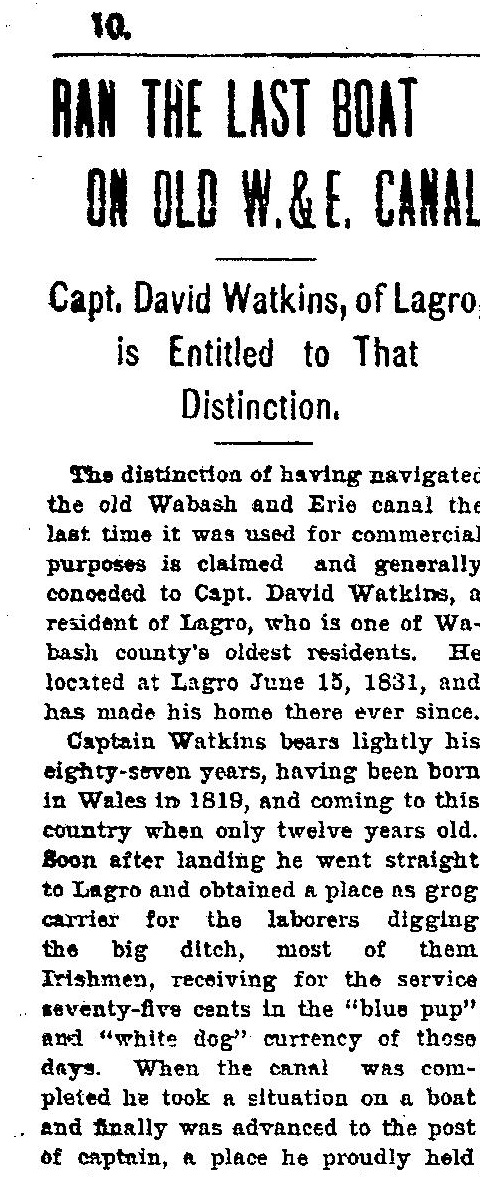
Henry Stevens had wheat coming in faster than he could put it anywhere. It was 1875, he was buying grain at Lagro, and he was, by the Sentinel's reckoning, probably the most prominent citizen of the place and a fighter. He had contracted to deliver a considerable quantity, the farmers were bringing it in rapidly, and he had nothing to store it in but a little elevator on the canal.
The reason he could not simply load it onto the railroad was that another buyer had leased the Wabash railroad's elevator at Lagro, and the railroad meant him to keep his monopoly.
the railway company sought to protect the elevator men in their monopoly of the grain trade at Lagro by a discriminating charge of several cents a bushel for loading cars through the elevator.
The charge fell on grain loaded straight off a farmer's wagon, which was the only way Stevens could load at all. When he would not pay it the road stopped setting him cars. He was, the paper says, very much distressed.
The canal was not an option. Boats on it had long since ceased running. Captain David Watkins had gone to other employment in Lagro, and his stake boat had sunk in the basin a mile west of the town and was slowly rotting where she lay. There was little prospect, as the Sentinel put it, of either the veteran commander or his craft sailing the decaying highway of commerce, which wound, a turgid, yellow stream, among the hills and along the beautiful valley of the Wabash.
Then Stevens worked out that the old Cincinnati, Wabash and Michigan railroad had been built into Wabash town, five miles off, and that its freight tracks ran along the very brink of the canal. Loading from a canal boat onto those cars would be easy and cheap. The difficulty was that there was no canal boat. He was turning this over when he ran into Watkins, and the idea arrived that the captain's old boat was still down there in the basin and might yet be strong enough to haul a few loads.
Watkins knew what he was being asked. Even if he raised her and caulked her spreading seams she would probably be unseaworthy, and might go to the bottom again with a full cargo. Stevens made him an offer.
I will give you steady employment for two months, at $5 a day for yourself and two men, handling two cars of wheat a day and will furnish you a mule and tow line. Rather than have the deal fall through I will give you your dinners at Arch Stitt's or Bill Ditton's.
He decided it was worth a trial. The next day he went down to the wreck. The water in the basin was shallow and he soon had the hull afloat, and within two days she was taking cargo at the old dock at Lagro. Two cars of wheat went aboard, the mule was hitched to the line, and the canal, which had filled during its long period of neglect, was shallow enough to be a worry and never once grounded her. He left Lagro early, reached Wabash about ten, transferred the sacked wheat to the cars standing conveniently by the old road, and was back at Lagro by three, ready to load for the next trip.
The trips were kept up through the summer. Stevens sent his wheat north, it came into Toledo over the Lake Shore road, and there it graded as Michigan wheat, which earned him two to four cents a bushel over the Indiana grades. When the season ended Watkins ran his boat back to the basin and anchored her, and thus ended for all time the navigation of the Wabash and Erie canal.
The last commercial voyage on that canal happened because a railroad priced a man off its own line. It paid, and it went on paying all summer.
The captain had been there from the beginning. Born in Wales in 1819, he came over at twelve, went straight to Lagro, and took the first work the canal offered.
Soon after landing he went straight to Lagro and obtained a place as grog carrier for the laborers digging the big ditch, most of them Irishmen, receiving for the service seventy-five cents in the "blue pup" and "white dog" currency of those days.
In 1843 two Fort Wayne merchants published a circular pricing the paper a farmer might be handed over a counter. Blue Pup, they wrote, was a shin plaster issued in small amounts by contractors on the Extension, payable in Blue Dog. Against old scrip they printed 85 or 90 cents on the dollar. Against Blue Dog, 40. Against Blue Pup they printed no figure at all, only a rule. That circular is The value in this market.
So the boy carrying whiskey to the diggers was being paid seventy-five cents a day in the one kind of paper the town's merchants would not put a price on. Forty-four years later he raised a rotting boat out of the mud and moved a summer's wheat with it, and then tied her up.
Sources
- Fort Wayne Weekly Sentinel, 19 April 1905, 1905. Internet Archive. The article headed Ran the Last Boat on Old W. and E. Canal, with the subheads Story of Last Trip, Situation Was Serious and Got Old Boat Afloat, printed page 10, scan leaf n9, finishing at the head of the second column
The text was read from scanned images. Every quotation was checked against the page image. The article fills the first column of the page and finishes at the head of the second. The year of the last voyage is read off the image as 1875; the scan's text layer renders it wrongly.