That glorious gate
Published .
On the morning of Thursday 30 July 1795, at Greenville in Ohio, a Miami chief stood up in council and said he had been appointed to speak for three nations that were not his own.
It is well known to you all, that people are appointed on those occasions, to speak the sentiments of others; therefore am I appointed for those three nations.
The man was Little Turtle. Across from him was Anthony Wayne, who had beaten the confederacy the previous August and had spent six weeks reading out the articles of a treaty and explaining them. Three days earlier Wayne had gone through the third article, which listed the ground the United States meant to keep inside Indian country. Among those pieces was a six miles square at the head of the Maumee, where the St. Joseph and the St. Mary's meet.
Wayne's argument for keeping those pieces was that they had been given away long ago, to somebody else.
You will consider that the principal part of the now proposed reservations were made and ceded by the Indians, at an early period, to the French; the French, by the treaty of peace of 1763, ceded them to the British; who, by the treaty of 1783, ceded all the posts and possessions they then held, or to which they had any claim, south of the great lakes, to the United States of America.
On that reading the six miles square was not being taken. It was being inherited.
Little Turtle answered at the only point where the argument could be tested, which was whether the first cession had ever happened.
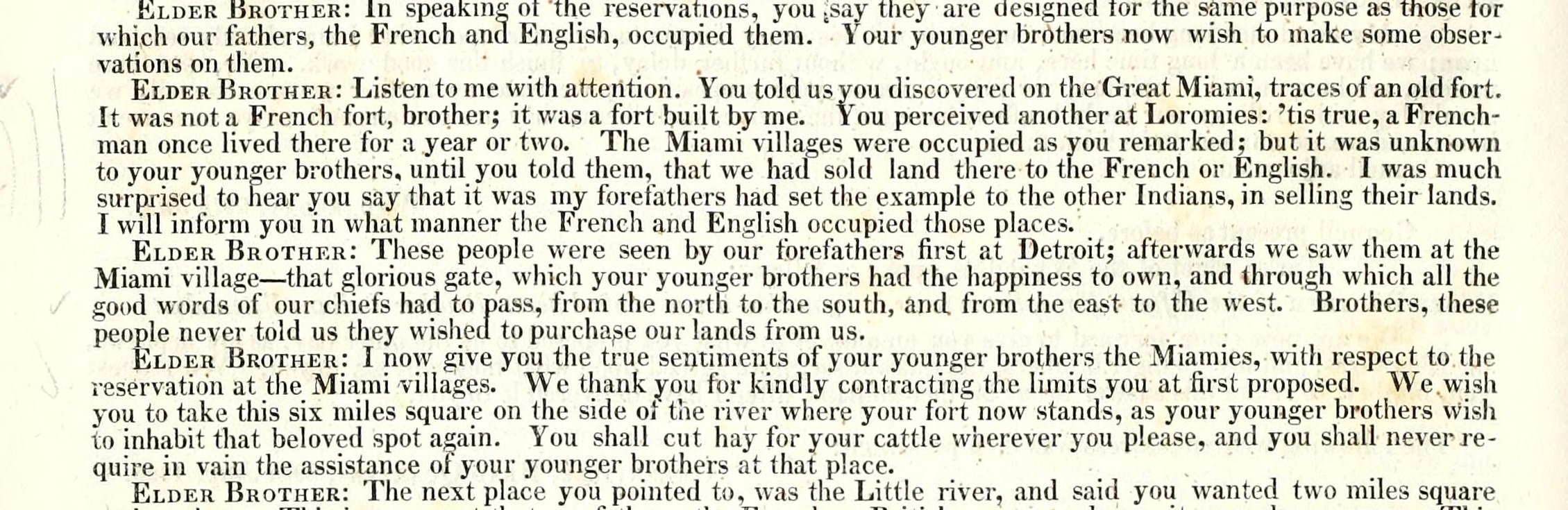
You told us you discovered on the Great Miami, traces of an old fort. It was not a French fort, brother; it was a fort built by me. You perceived another at Loromies: 'tis true, a Frenchman once lived there for a year or two. The Miami villages were occupied as you remarked; but it was unknown to your younger brothers, until you told them, that we had sold land there to the French or English.
Wayne had read ruins as evidence of an old European title. Little Turtle told him one set was his own work, that a man living somewhere for a year or two is not a purchase, and that the Miami had learned they sold the Miami villages only when Wayne informed them of it.
Then he said what the place had been.
These people were seen by our forefathers first at Detroit; afterwards we saw them at the Miami village, that glorious gate, which your younger brothers had the happiness to own, and through which all the good words of our chiefs had to pass, from the north to the south, and from the east to the west. Brothers, these people never told us they wished to purchase our lands from us.
A gate, not a village. Everything moving between the lakes and the Ohio country went over the carrying place there. He says his people had the happiness to own it, in the past tense, in front of the man who had just built a fort on it.
Wayne answered the same day, and he answered the fort directly.
I find there is some objection to the reservation at fort Wayne. The Little Turtle observes, he never heard of any cessions made at that place to the French. I have traced the lines of two forts at that point; one stood near the junction of the St. Josephs with the St. Mary's, and the other not far removed on the St. Mary's; and it is ever an established rule, among Europeans, to reserve as much ground around their forts, as their cannon can command.
One man says he never heard of a cession. The other answers with ruins and a rule about cannon range, and calls that rule as well known as any other fact. Neither produces a deed. The dispute is over whether the remains of a building are the remains of a purchase.
Wayne also gave back, in his own words, the phrase he had just been handed.
those people, who have lived at that glorious gate, (the Miami villages,) may now rekindle their fires at that favorite spot
Little Turtle had used the phrase to say what had been lost. Wayne repeated it to say nothing had been.
What Little Turtle asked for, on the reservation itself, he asked plainly, and it is the last thing he says about this ground that day.
We thank you for kindly contracting the limits you at first proposed. We wish you to take this six miles square on the side of the river where your fort now stands, as your younger brothers wish to inhabit that beloved spot again. You shall cut hay for your cattle wherever you please, and you shall never require in vain the assistance of your younger brothers at that place.
Take the side the fort is already standing on. Leave the other. Cut hay anywhere, and ask for help and it will come.
The six miles square is in the treaty. So is the portage road running from it to the Little river, which he had also objected to, and which Wayne kept on the ground that the United States would always be its own carrier.
Sources
- American State Papers, Class II, Indian Affairs, volume 1, 1832. Internet Archive. The Greenville council proceedings. Wayne on the third article and the cession to the French, 27 July 1795, printed page 574, scan leaf n579; Little Turtle's speech of 30 July, the old fort on the Great Miami, that glorious gate and the six miles square, printed page 576, scan leaf n581; Wayne's reply the same day on the reservation at fort Wayne, the two traced forts and the rekindled fires, printed page 578, scan leaf n583
The text was read from scanned images. Every quotation was checked against the page image.
More from Fort Wayne
Fort Wayne
The Edsalls know no such word as fail
In March 1844 Samuel Edsall asked Fort Wayne for a bridge over the St. Mary's and took the contract himself. He took the plank road to Bluffton partly in stock, and the second and third courthouses as contractor.