The beavers had made a dam
Published .
Some working oxen and horses left Detroit on a September morning in 1778 and walked south. They were sent to the head of the Maumee, to the strip of ground between that river and the streams running the other way, where goods coming down from the lakes had to be taken out of the boats and carried. Three days later a lieutenant went after them.
27th. Ordered a Lieut of the Indian Department with a small party of the Militia to the Miamis to assist the workmen in repairing the carrying place, assisting the Master Carpenter, Boat builder &c, with written instructions.
The man who sent them was Henry Hamilton, lieutenant governor at Detroit. He was preparing to take a force down to Vincennes, which an American officer had taken from the British that summer, and everything he meant to take with him had to cross that strip of ground. He wrote to his commander in chief about it while the oxen were still on the road.
I design forming a depot at the Miamis, but shall take a survey of the Portage before I fix on its being on this or the other side of the carrying place: should the Indians act with zeal for us, it shall be on the other side, if cooly on this.
He was proposing to put his magazine on one bank or the other depending on how the Miami received him. He had not seen the place, and he would not settle it until he arrived.
He left Detroit on 7 October with one field piece, about seventy volunteers, two serjeants and thirty rank and file of the King's Regiment, and about sixty Indians. A storm nearly ended it on the lake within four days. A lieutenant's musket went off and shattered his leg, and he was sent back by boat to Detroit, where the leg was taken off and he died of it anyway. The water was low all the way up.
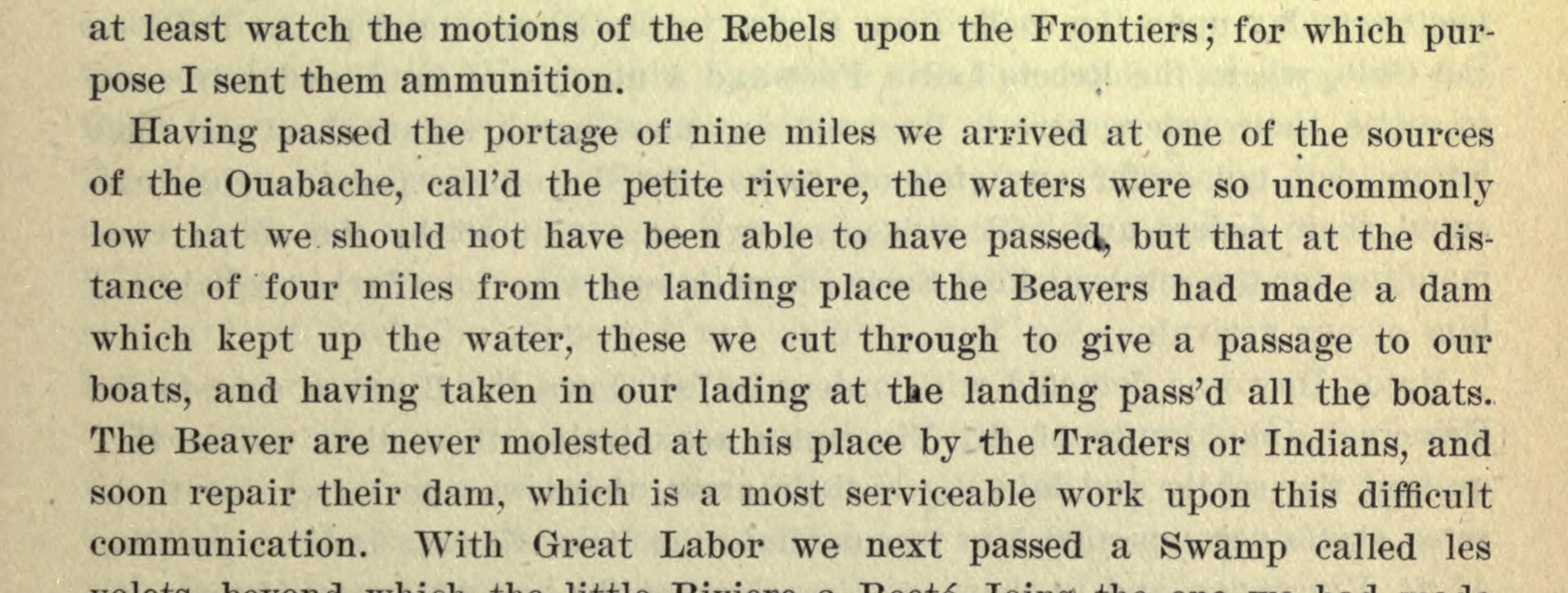
On the 24th we arrived at the Miamis Town after the usual fatigues attending such a navigation the water being remarkably low. Here we met several Tribes of the Indians previously summoned to meet here, and held several conferences, made them presents, and dispatched messengers to the Shawanese as well as the nations on our route, inviting them to join us or at least watch the motions of the Rebels upon the Frontiers; for which purpose I sent them ammunition.
That is the whole of what he wrote about the town itself. The conferences are summed up in one clause. He does not say who spoke, or where he camped, or what the place looked like. The nine miles of carrying place he had been thinking about for a month gets a subordinate phrase.
What he wrote at length about was the water on the other side.
The portage put the boats into the petite riviere, one of the sources of the Wabash, and the petite riviere was too shallow to float them. The expedition should have stopped there. It did not, because of something four miles below the landing place.
the waters were so uncommonly low that we should not have been able to have passed, but that at the distance of four miles from the landing place the Beavers had made a dam which kept up the water, these we cut through to give a passage to our boats, and having taken in our lading at the landing pass'd all the boats.
A six pounder, ninety seven thousand pounds of provisions and stores, and something under two hundred men went down that stream on water an animal was holding back. Hamilton cut the dam, ran the boats through on the release, and then wrote a sentence that says more about the place than anything else in his account.
The Beaver are never molested at this place by the Traders or Indians, and soon repair their dam, which is a most serviceable work upon this difficult communication.
The beaver at that spot were worth more standing than skinned, and everybody using the portage knew it. Traders whose whole business was pelts left those ones alone. The dam was maintained by its builders at no cost to anyone and protected by a rule nobody had written down. Hamilton noticed it because he had just been saved by it.
Below that the river got worse. The frost lowered it further, the floating ice cut the men as they worked in the water to haul the boats over shoals and rocks, and the whole ninety seven thousand pounds had to come out and go back in each time a boat was lightened. It was sometimes a day's work to get the distance of half a league. They reached Vincennes on 17 December, seventy one days out of Detroit for six hundred miles.
Hamilton held it until February, when the American officer came back across the flooded Illinois country and took it again, and took Hamilton with it. The narrative quoted here was written afterwards, by a man explaining a campaign that had ended with his own capture.
He gave his own numbers with a parenthesis around them: by recollection, the rebels having got possession of the returns with his other papers.
Sources
- Michigan Historical Collections, volume 9, 1886. Internet Archive. The Haldimand Papers. Hamilton's dispatch of 22 September to 3 October 1778, the depot and the survey of the portage, printed page 478, scan leaf n493; the order sending a lieutenant and a party of militia to the carrying place, printed page 480, scan leaf n495; his numbers given by recollection, printed page 492, scan leaf n507; the arrival at the Miamis Town on 24 October, the portage of nine miles and the beaver dam, printed page 493, scan leaf n508; the frost, the floating ice and the ninety seven thousand pounds, printed page 494, scan leaf n509
- Michigan Historical Collections, volume 10, 1886. Internet Archive. The Haldimand Papers. Hamilton from Rocher de Bout, 14 October 1778, saying he would write again from the Miamis town, printed page 303
The text was read from scanned images. Every quotation was checked against the page image.
More from Fort Wayne
Fort Wayne
The Edsalls know no such word as fail
In March 1844 Samuel Edsall asked Fort Wayne for a bridge over the St. Mary's and took the contract himself. He took the plank road to Bluffton partly in stock, and the second and third courthouses as contractor.