The goods from Fort Wayne
Published .
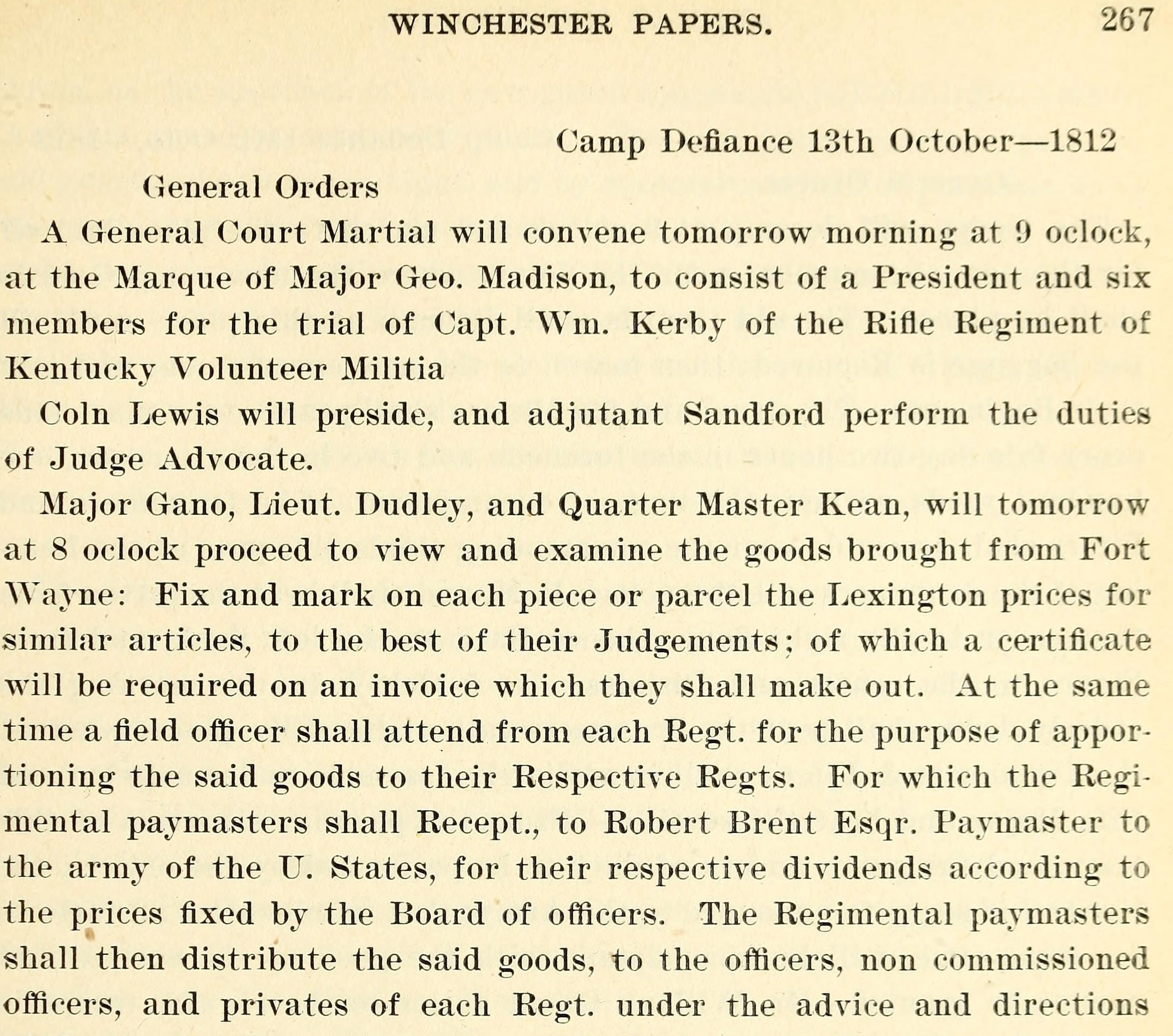
At eight o'clock on the morning of 14 October 1812, three officers were to go and look at some merchandise. Major Gano, Lieutenant Dudley and Quartermaster Kean had been named to it the day before, in general orders issued at Camp Defiance, and what they were to examine had come out of Fort Wayne.
Major Gano, Lieut. Dudley, and Quarter Master Kean, will tomorrow at 8 oclock proceed to view and examine the goods brought from Fort Wayne: Fix and mark on each piece or parcel the Lexington prices for similar articles, to the best of their Judgements; of which a certificate will be required on an invoice which they shall make out.
Lexington is in Kentucky. The three men were to walk along whatever had been carried out of the fort, decide what each piece would have fetched in a Kentucky town, write the figure on it, and then sign an invoice saying they had.
The order had been given four days earlier in a looser form, and it says who was to do the pricing and on what principle.
On Sunday next the goods from Fort Wayne shall be valued to the Lexington prices of similar articles and the valuation, or prices of each article shall be marked thereon by three commissioned officers, well acquainted with the Value of Merchandize to be selected for that purpose
Not any three officers. Three who knew what goods were worth.
at the same time a deputation of one Field officer from a Regiment shall divide said goods in proportion to the strength of each Regiment
Divided by how many men each regiment had. And then:
The Regimental paymasters shall Recept., to Robert Brent Esqr. Paymaster to the army of the U. States, for their respective dividends according to the prices fixed by the Board of officers. The Regimental paymasters shall then distribute the said goods, to the officers, non commissioned officers, and privates of each Regt.
So the goods were not stores and they were not plunder in the army's own accounting. They were priced, receipted to the Paymaster of the United States at the figures the board had fixed, drawn by each regiment as a dividend, and handed down to officers, sergeants and privates. Whatever came out of Fort Wayne reached the men as something they had been charged for.
The army doing this had been outside the fort three weeks earlier. The order book opens on the road, and it measures where it is by how far it has got from the place.
Camp 28 miles from Fort Wayne Sept. 25th 1812
The next day's orders are headed from thirty-three miles. They are the orders of a force that expects to be attacked: the flank line never to go beyond the sound of the centre line's drum, the advanced guard never beyond the sound of the pioneers' axes, nobody to straggle on any pretence under penalty of four days' close confinement and half rations, and every night's camp to be fortified.
The fortification around the encampment shall be in right lines, and raised at least four feet high, and not nearer, and not nearer than 20 nor less than 15 feet in front of the front line of t
The printing breaks off there, mid-sentence, and picks up with the next order. The words are not in the book.
Why the army had been at Fort Wayne at all is not in these orders either. The volume's editor supplies it, in a bracketed passage before the journal begins, footnoted to five printed works: he writes that the fort had been understood to be invested by the Indians and British, that Harrison marched to relieve it and found the besiegers gone, that detachments went out to destroy villages and crops, and that Winchester reached the fort on 19 September and took command. That is the editor of 1901 telling it, not the general.
What the general's own book says about Fort Wayne is four things: two distances, and these two orders about goods.
It does not say whose goods they were. It does not say what they were, beyond pieces and parcels of merchandise. It does not say whether they were bought from somebody, taken up by the army, or carried off. It does not say who brought them, or when, or how far. The orders begin at the point where the goods are already at Camp Defiance and the only question left is what they are worth.
One more thing sits on the page without explanation. The general signs the opening order as commanding the North West Army. On the leaf carrying the first of the goods orders he signs differently.
J. Winchester B. Genl. Comdg. left. Wing N. W. Army
The left wing. Nothing in the orders accounts for the change.
Sources
- Michigan Historical Collections, volume 31, 1902. Internet Archive. The Winchester Papers. General orders of Brigadier General James Winchester: Camp 28 miles from Fort Wayne, 25 September 1812, with the order on the lines of march and the encampment, scan leaf n279; Camp Defiance, 9 October 1812, after orders, on the valuation of the goods from Fort Wayne to Lexington prices and their division among the regiments, scan leaf n288; Camp Defiance, 13 October 1812, general orders, naming Major Gano, Lieutenant Dudley and Quartermaster Kean to view and examine the goods and the regimental paymasters to receipt them to Robert Brent, printed page 267, scan leaf n290
The text was read from scanned images. Every quotation was checked against the page image. The 1902 printing breaks off mid-sentence in the order of 25 September 1812 and the missing words are not supplied here. The spellings in the quotations are the writer's own; the volume's editor states that spelling and punctuation have been faithfully copied.
More from Fort Wayne
Fort Wayne
Boiling down their ashes to black salts
In November 1843 a man named Miller began building an ashery in Fort Wayne, and several farmers had bought kettles to boil their ashes down to black salts. In 1845 Miller wanted a hundred tons. In 1854 the last call for black salts ran three weeks.