Fort Wayne
A total loss to the Seminary Fund
Published .
In the winter of 1826 John P. Hedges had the schoolhouse plastered, and paid for it himself, so that it might be, in the words later set down about him, "the more comfortable and neat."
It was a one-story brick building on a lot beside the old graveyard, behind where the county jail would later stand. It had gone up in 1825, and people called it the County Seminary. Barr and McCorkle, who laid out the town, had set the lot apart for "an educational institute or seminary." Hedges taught there from about 1826. Joseph Boggs followed him, then Jesse Aughinbaugh in 1832 and 1833, Smallwood Noel and James Requa in 1834 and 1835, Myron F. Barbour in 1835 and 1836, and John C. Sivey in 1836. The building served for worship, town meetings, Masonic installations and political speeches as well.
Across the public square a lawyer named Henry Cooper was teaching in the upper story of the log jail. "Light and air were admitted through the iron grates of the two small openings called windows," a Fort Wayne school superintendent wrote in 1880. The floor was hewn logs. The seats were, he wrote, "of the rudest description." Who taught first in the town, Cooper or Hedges or the missionaries before either of them, the old histories do not agree.
The seminary was meant to be paid for by the courts. The county clerk kept an account called the Seminary Fund, and what it was owed was the fines and forfeitures of the circuit court and the justices of the peace. When the circuit court sat in Fort Wayne in November 1825, according to the historian B. J. Griswold, it found General John Tipton, the Indian agent, guilty of assault, and he was fined $3 "for the use of the county seminary." Most of the fines were smaller cases than that. Men selling liquor without a licence paid $3 and costs. A gambler paid $10.
The money did not arrive the way the law pictured it.
In April 1841 the clerk, P. G. Jones, laid the account before the grand jury. The fines and forfeitures accrued in the circuit court since 1824 came to $3,392.70. Justices of the peace had reported another $245.76 since 1838, and before that, Jones wrote, "I can find no reports on record." Of all of it, $238.31 had been collected. The governor had remitted a $200 forfeiture against J. P. Hedges and L. P. Ferry, and $50 against Amos Compton. Forfeitures of $500 against Ira Andrews, $500 against J. C. Kinney and Silas Powell, and $400 against John Vangelder could not, Jones believed, be collected "for some length of time, and some it most likely never."
The grand jury, John Spencer foreman, answered on 5 April. "We the Grand Jurors," it wrote, "do present that the Seminary Funds are in a deplorable condition, caused by the manner it has been attended too." It asked for the money on hand to be put in a bank for safe keeping, and for three seminary trustees to be elected as the law provided. It asked for the report to be printed in both town papers, and the Sentinel printed it.
Sixteen months later another grand jury went through the figures again. Since October 1838, it found, $2,828.62 in fines had been assessed in the circuit court, and $217.81 collected. "Upwards of seven eights of all the fines assessed since Oct. 1838," it wrote, "are reported as not collected or collectable and consequently are a total loss to the Seminary Fund." The years before 1838 had never been examined. That, the jurors wrote, was a matter "agitated by every Grand Jury for several years, and all to no purpose."
By then the graves beside the schoolhouse had been moved, in 1838 and 1839, to the new cemetery west of town. Writing in 1872, John W. Dawson remembered an old brick schoolhouse there with a cemetery around it, "rude palings and other plain marks of affection around the graves." The superintendent in 1880 could not say how long each of the early teachers had stayed. Nobody left a date for the last day of school in the seminary.
Indiana gave up on county seminaries. An act approved 12 June 1852 provided for selling them and turning the proceeds over to the common school fund. In January 1855 the county auditor and treasurer advertised the Allen County Seminary lots, numbers 192, 193 and 194 in Hanna's Addition, for public sale at the courthouse door on Monday 26 March, at one o'clock. The buyer would pay six per cent interest a year in advance and the principal in ten equal annual instalments.
The Sentinel did not report who bought them or for what.
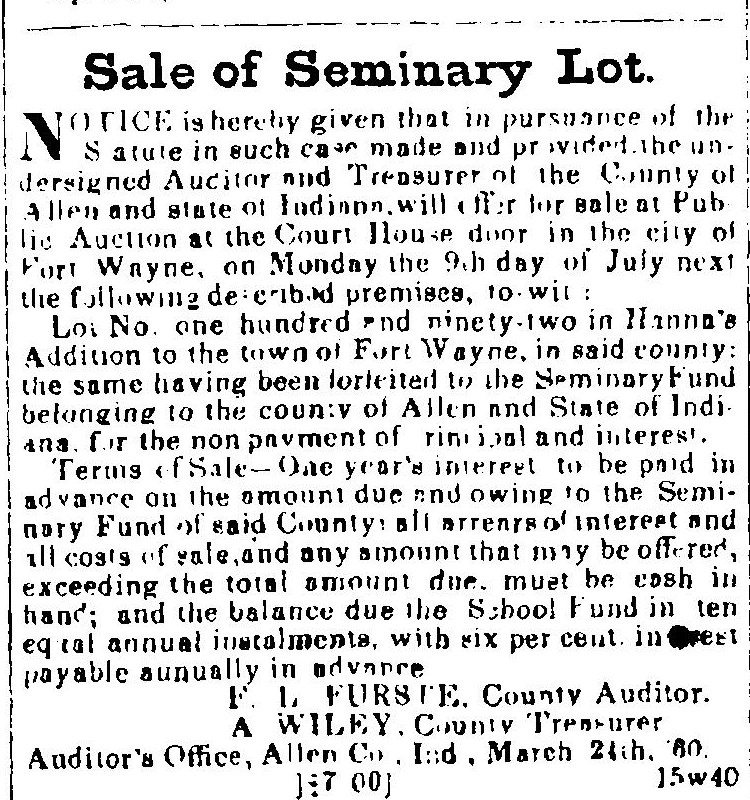
In the spring of 1860 the notice ran again, for one lot. Lot 192 in Hanna's Addition would be offered at the courthouse door on 9 July, "the same having been forfeited to the Seminary Fund belonging to the county of Allen and State of Indiana, for the non payment of principal and interest."
Sources
- Fort Wayne Sentinel, 8 May 1841. Internet Archive. Scan leaf n5. The clerk's report on the Seminary Fund, signed P. G. Jones, and the grand jury presentment, dated 5 April 1841
- Fort Wayne Sentinel, 3 September 1842. Internet Archive. Scan leaf n5. Grand jury presentment, August term 1842
- Fort Wayne Sentinel, 13 January 1855. Internet Archive. Scan leaf n2. Notice of sale of the Allen County Seminary lots
- Fort Wayne Sentinel, 28 April 1860. Internet Archive. Scan leaf n2. Sale of Seminary Lot, dated 24 March 1860
- History of Fort Wayne, Wallace A. Brice, 1868. Internet Archive. Scan leaves n325 and n326
- History of Allen County, Indiana, Kingman Brothers, 1880. Internet Archive. J. S. Irwin's schools chapter, scan leaf n106
- Volume 2 of the Valley of the Upper Maumee River, 1889. Internet Archive. Bench and Bar chapter, the November 1825 term
- The Pictorial History of Fort Wayne, Indiana, B. J. Griswold, 1917. Internet Archive. Scan leaves n289 and n292. John W. Dawson's words of 16 March 1872 are quoted as Griswold printed them at n292
The text was read from scanned images. Every quotation was checked against the page image.
More from Fort Wayne
Fort Wayne
Without any provocation
A private pleaded guilty to rioting in the public cornfield. Three men were then sworn, and what they said was not about the riot. The commanding officer punished the other man too, without charging him.