Fort Wayne
More than they are either able or willing to bear
Published .
Thomas Tigar set his own name at the top of the Fort Wayne Sentinel every week, as editor and publisher. On Saturday 11 June 1853 he gave a paragraph to a meeting the city would hold at the courthouse the following Saturday.
The voters were to decide whether to levy a tax of 50 cents on each $100 of property, and 50 cents on every poll, "for the purpose of purchasing sites and erecting school-houses within the city."
Tigar did not call the object a bad one. "The object of this tax is no doubt a praiseworthy one," he wrote, "and one that in ordinary times would be cheerfully complied with." He doubted whether the school tax already being paid was doing much good without rooms to teach in.
Then he turned. "But our citizens are already so heavily taxed this year, having to plank the side walks and crossings, build a market house, &c., &c., in addition to the regular taxes, that the proposed heavy addition of 50 cents on the $100 may prove more than they are either able or willing to bear."
Fort Wayne had no public schoolhouse. Under the state's new school law of 1852 the city had three school trustees: Hugh McCulloch, Charles Case and William Stewart. When they took office, by the account of a man who later ran the system himself, they had 1,200 school children, "a tuition fund of $300, no building nor school appliances and not a dollar to buy them."
The meeting had not been their idea alone. Their clerk, John Conger, gave notice in May that it was called "in pursuance of an application made to the Trustees of Common Schools," which is to say that citizens had asked for it. Who signed that application, the notice does not say.
On the morning of the vote the Sentinel reminded its readers that it was "To Day." The polls at the courthouse were open from ten until four.
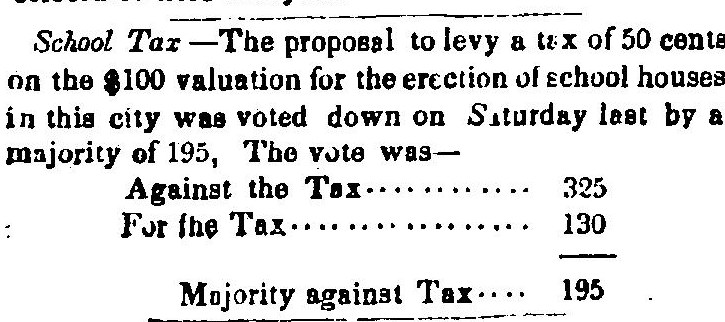
The next week's paper gave the result in four lines of type.
"The proposal to levy a tax of 50 cents on the $100 valuation for the erection of school houses in this city was voted down on Saturday last by a majority of 195."
Against the tax, 325. For it, 130.
No one who wrote about the vote afterwards saw it the same way twice. John S. Irwin, the city's school superintendent, gave it one sentence in 1880: a vote "to raise a special fund by taxation, was lost." Irwin had come to Fort Wayne in 1853, a bank bookkeeper, and did not join the school board until 1865. A county history of 1889, whose school chapter is unsigned, was harder. "The purpose of the meeting ignominiously failed, and the trustees resigned." B. J. Griswold, in 1917, put the resignations earlier, in a quarrel over money in April. McCulloch, Case and Stewart were gone from the board by 1854, and the three books do not agree on the order of events.
The trustees who followed them opened school in rented rooms: Alexander McJunkin's old schoolhouse on Lafayette Street and a small house belonging to A. M. Hurlburd. Two years after the vote the Sentinel was printing a Toledo report on that city's schools and asking what the difference was. "It is certainly time we had free schools in Fort Wayne," the paper said in April 1855; "our present destitute condition is a reproach and disgrace to our city."
In 1855 the board bought two lots, one from Samuel Hanna on the east side and one from Dr. Charles E. Sturgis on the west, and advertised for builders. Nobody bid. The trustees let the east building a piece at a time, as Irwin put it, "as persons were found willing to take the risks."
It opened on Monday 9 February 1857. "The public school, at the corner of Clay and Washington Streets, was formally opened on Monday last, with appropriate exercises," the Sentinel reported. Charles Case, one of the three original trustees, was among the speakers.
The west building needed another kind of help. In September 1857, Irwin wrote, the trustees built it "with the aid of several citizens, who, for this purpose voluntarily mortgaged their private property." The 1889 history made them ten gentlemen, $500 each, lent to the trustees, who promised to pay the interest. Neither book names them. Neither says whether the mortgages were ever paid off. The 1889 history says only that the board of 1865 inherited "a magnificent debt."
The city itself tried to pay $3,500 toward the west building in November 1857. The city treasurer refused, and a Mr. M. Jenkinson went to court for an injunction to stop the money. The Sentinel called the treasurer "a tool by the enemies of our School system."
In May 1858 the city elected three school trustees. The Sentinel printed their names: W. Rockhill, S. Edsall and T. Tigar.
Sources
- Fort Wayne Sentinel, 23 May 1853. Internet Archive. Scan leaf n2. The school tax notice signed by John Conger, dated 27 May 1853. The Internet Archive dates this item 23 May
- Fort Wayne Sentinel, 11 June 1853. Internet Archive. Scan leaf n0 and n1. Masthead and editorial
- Fort Wayne Sentinel, 13 June 1853. Internet Archive. Scan leaf n1. "To Day". The dateline on this item reads Saturday, 18 June 1853
- Fort Wayne Sentinel, 25 June 1853. Internet Archive. Scan leaf n1. The result
- Fort Wayne Sentinel, 14 April 1855. Internet Archive. Scan leaf n1. Free schools
- Fort Wayne Sentinel, 14 February 1857. Internet Archive. Scan leaf n1. The opening of the school at Clay and Washington
- Fort Wayne Sentinel, 14 November 1857. Internet Archive. Scan leaf n1. The city treasurer and the injunction
- Fort Wayne Sentinel, 8 May 1858. Internet Archive. Scan leaf n1. The school trustees elected
- History of Allen County, Indiana, Kingman Brothers, 1880. Internet Archive. J. S. Irwin, "Our Common Schools", from scan leaf n106; the public schools at n107
- Valley of the Upper Maumee River, 1889. Internet Archive. "Schools", scan leaves n521 and n522; the list of trustees at n527 and n528
- The Pictorial History of Fort Wayne, Indiana, B. J. Griswold, 1917. Internet Archive. Scan leaf n513
The text was read from scanned images. Every quotation was checked against the page image.
More from Fort Wayne
Fort Wayne
Without any provocation
A private pleaded guilty to rioting in the public cornfield. Three men were then sworn, and what they said was not about the riot. The commanding officer punished the other man too, without charging him.