Fort Wayne
Taken as the property of the Trustees
Published .
On a Wednesday in June 1847 a procession formed at the Methodist church in Fort Wayne and walked to the ground William Rockhill had given at the end of West Wayne Street. The Reverend Mr. Wood prayed. Hugh McCulloch said a few words. Then the corner stone of the Fort Wayne Female College went into place, with a box sealed inside it holding the list of subscribers, the names of the trustees, the Fort Wayne papers and a number of other documents.
The procession moved on to a grove on the bank of the river, near the new building, and the Reverend Samuel Brenton gave an address.
The editor of the Sentinel was there. The building, he wrote, would be finished in the course of the next year, "and will be one of the largest and most imposing in the state." In the meantime the trustees had rented a house in the Rockhill Addition, "where upwards of thirty young ladies have already commenced their studies."
The idea was a year old. In July 1846 the friends of a female seminary "proposed to be established here under the auspices of the Northern Indiana Conference" had met in the Methodist church on a Tuesday evening, appointed committees and adjourned. That winter the legislature passed the bill incorporating the college. Its charter let the trustees confer "the highest literary degrees and honors usual in Female Colleges."
On the last two days of December 1847 the students were examined in the Methodist church. The committee of townsmen who sat through it reported that the school was under the charge of A. C. Huestis, assisted by Miss Abigail Keis, Miss Elisabeth F. Irving and Miss Jane H. Irving. In mathematics, they wrote, questions were chosen at random and "the solution was instantly given on the black board before us."
The teachers and the girls boarded together, "and thus form one family." The college advertised a primary department for spelling, reading, writing, arithmetic and geography, a preparatory department, a collegiate department, and tuition on the piano or seraphin.
In the summer of 1849 the trustees and visitors elected a new faculty, with the Reverend Cyrus Nutt as president and Huestis as professor of mathematics and natural science. The paper added one line. "There have been 142 young ladies in attendance during the past collegiate year."
The building went up in stages. In April 1851, after the annual examination, a collection taken up on a Tuesday evening raised $562 "to aid in finishing the Chapel of the College."
By then boys were being taught as well. In October 1855 the school advertised itself as the Fort Wayne Female College and Collegiate Institute, under R. D. Robinson as president. Tuition for a fourteen-week term was $2.50 in the primary department, $4.50 in the academic and $7.50 in the college. Young ladies could board in College Hall at $1.75 a week. Young gentlemen boarded with families in town, at $2.00 to $2.25.
On the evening of 21 November 1856 a storm came through the city. "A large portion of the roof of one of the wings of the Methodist Female College was blown off," the Sentinel reported the next morning.
In the spring of 1858 the college's name appeared in a different column.
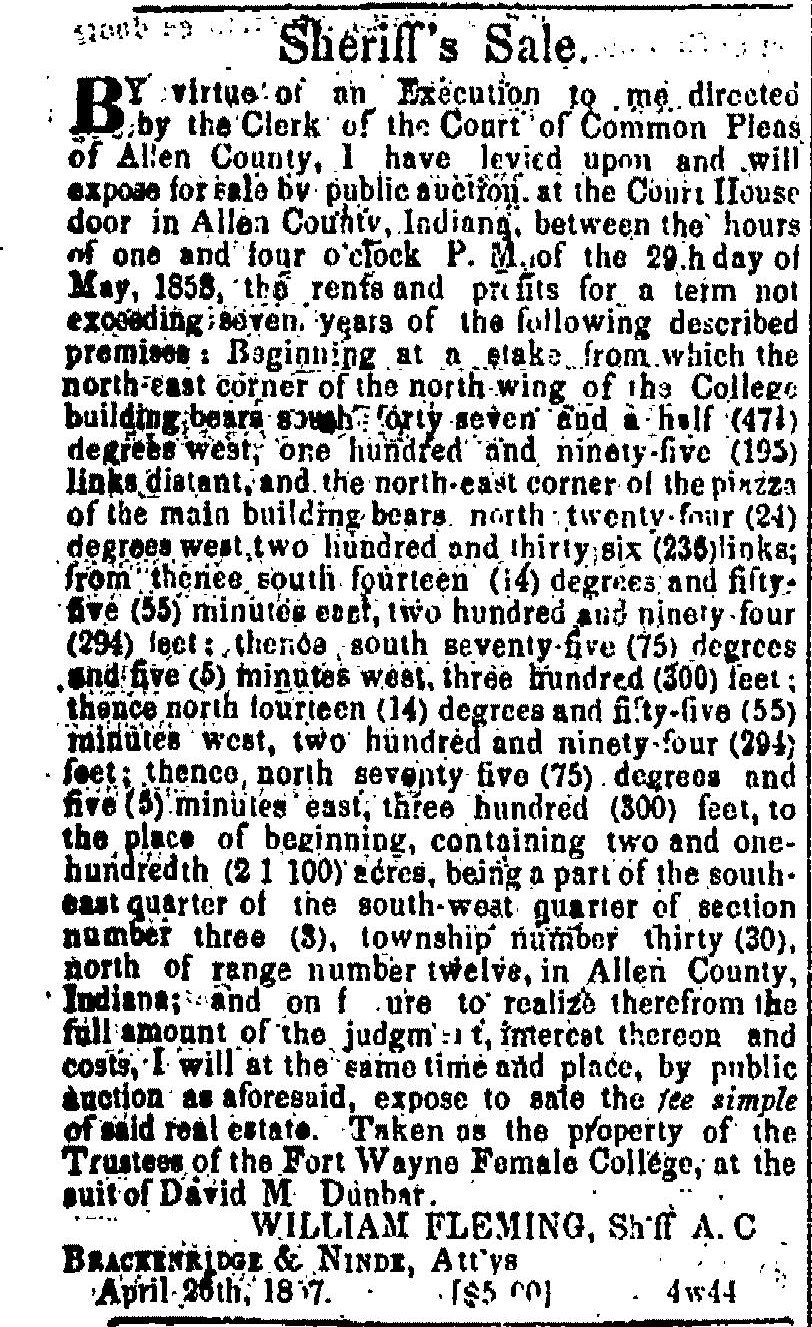
A judgment had been entered against the trustees in the Court of Common Pleas of Allen County, and the clerk had issued an execution to the sheriff, William Fleming. Fleming levied on the ground under the college. His notice described it to the link: a tract of two and one hundredth acres, measured from a stake by the north-east corner of the north wing of the College building and the north-east corner of the piazza of the main building.
The law set the order of the sale. On 29 May 1858 he would first offer the rents and profits of the land for a term of up to seven years. If that did not raise the full amount of the judgment, interest and costs, he would sell the fee simple, the land itself, at the same time and place.
Taken as the property of the Trustees of the Fort Wayne Female College, at the suit of David M. Dunbar.
The notice gives no sum and no reason. It does not say who David M. Dunbar was, and nothing else in the paper does either. Its date line is set in broken type in some printings, and where it can be read it says April 1857, a year before the sale it announces.
The day before the sale, the sheriff added a line. The sale was postponed until 24 July 1858. The notice ran for the last time on 17 July, and after that it stopped.
The Sentinel never said what happened on 24 July. On 11 September it carried two lines under the heading Fort Wayne College. "The Fall Session will commence on Tuesday September 21st, and continue fourteen weeks."
The next spring Robinson was still president.
Sixty years later a Fort Wayne historian gave the whole school a sentence. It had been "allowed in later years to succumb beneath the weight of debt." By then the site of the campus was a residential street, and nothing was left of the building that was to have been one of the largest and most imposing in the state.
Sources
- Fort Wayne Sentinel, 25 July 1846. Internet Archive. Scan leaf n1. The meeting of the friends of a female seminary
- Fort Wayne Sentinel, 26 June 1847. Internet Archive. Scan leaf n1. The corner stone
- Fort Wayne Sentinel, 31 July 1847. Internet Archive. Scan leaf n3. The college's advertisement
- Fort Wayne Sentinel, 8 January 1848. Internet Archive. Scan leaf n1. The examination committee's report
- Fort Wayne Sentinel, 4 August 1849. Internet Archive. Scan leaf n1. The faculty of 1849
- Fort Wayne Sentinel, 26 April 1851. Internet Archive. Scan leaf n1. The chapel collection
- Fort Wayne Sentinel, 6 October 1855. Internet Archive. Scan leaf n1. The Collegiate Institute's terms
- Fort Wayne Sentinel, 22 November 1856. Internet Archive. Scan leaf n1. The storm
- Fort Wayne Sentinel, 1 May 1858. Internet Archive. Scan leaf n6. The sheriff's notice
- Fort Wayne Sentinel, 5 June 1858. Internet Archive. Scan leaf n6. The postponement, dated 28 May 1858
- Fort Wayne Sentinel, 17 July 1858. Internet Archive. Scan leaf n6. The last printing of the notice
- Fort Wayne Sentinel, 11 September 1858. Internet Archive. Scan leaf n1. Fort Wayne College, the fall session
- History of Allen County, Indiana, Kingman Brothers, 1880. Internet Archive
- Volume 2 of the Valley of the Upper Maumee River, 1889. Internet Archive. Methodist churches chapter, "Fort Wayne College"
- History of the Maumee River Basin, Charles E. Slocum, 1905. Internet Archive. Volume 1
- The Pictorial History of Fort Wayne, Indiana, B. J. Griswold, 1917. Internet Archive. Scan leaves n400 and n401
The text was read from scanned images. Every quotation was checked against the page image.
More from Fort Wayne
Fort Wayne
Without any provocation
A private pleaded guilty to rioting in the public cornfield. Three men were then sworn, and what they said was not about the riot. The commanding officer punished the other man too, without charging him.