Obeyed and respected accordingly
Published .
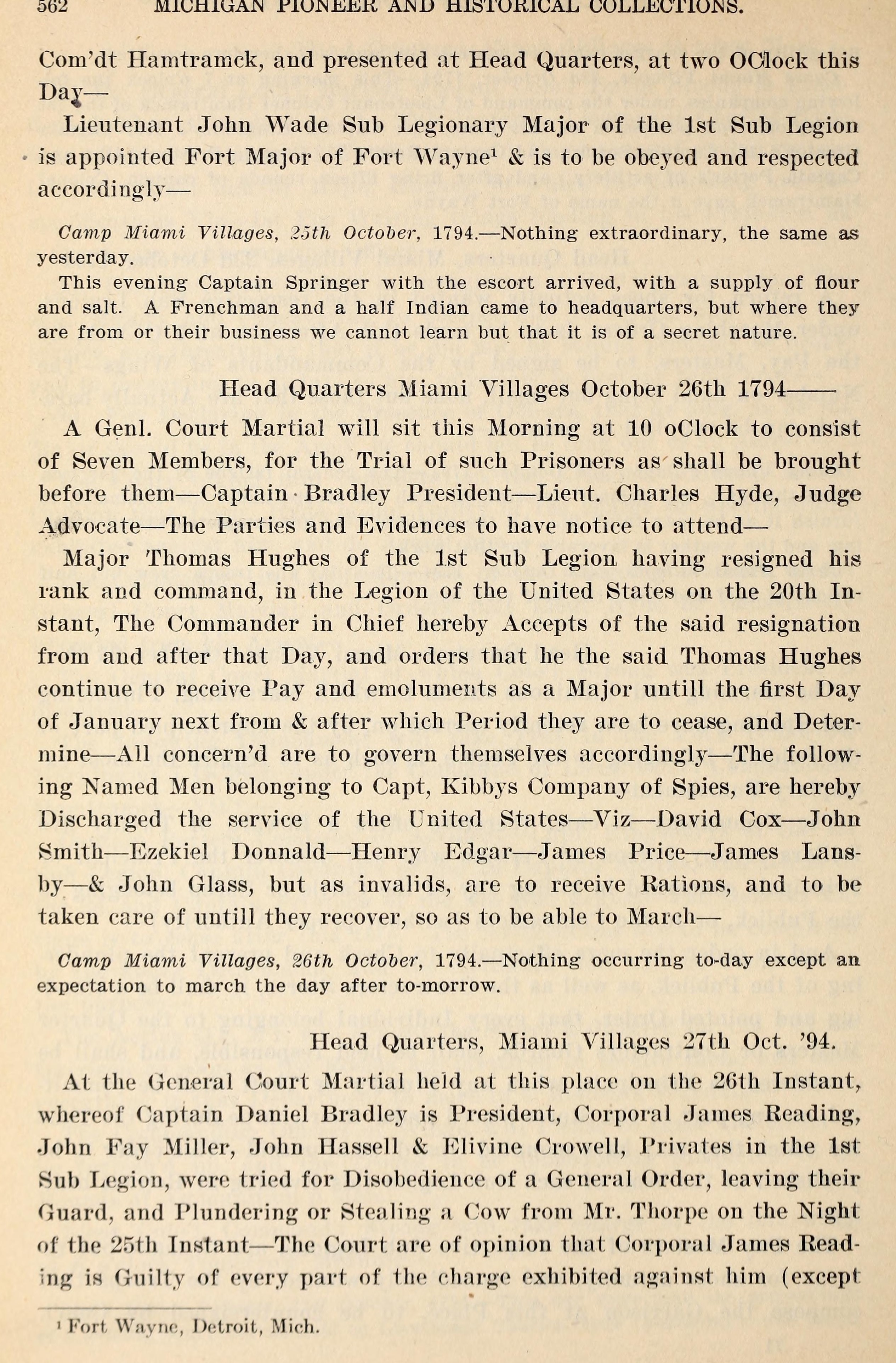
On 25 October 1794, at head quarters among the Miami villages, Anthony Wayne put his name to an order about thieves.
The alarming and Villainous excess to which Marauding, Plundering and Stealing have been recently carried on, by the unprincipled part of the Soldiery belonging to the Legion, is such as to require the most exemplary Punishment
He offered a reward of twenty five dollars to anyone who would give up the principals. Further down the same order, after a paragraph about returns to be presented to the commandant at two o'clock, he gave a man a fort.
Lieutenant John Wade Sub Legionary Major of the 1st Sub Legion is appointed Fort Major of Fort Wayne & is to be obeyed and respected accordingly
That is the whole of it. A rank, a sub legion, a post, and an instruction to everyone else about how to treat him.
The fort had been named four days earlier, and this archive has the piece about how that happened. This order is what came next: the general who had built the place handing it to somebody to keep, in the same breath as telling the army to stop robbing the country around it.
It is worth seeing where the sentence sits. It is not a proclamation. It comes after a reward notice and after a line about returns of some kind, to be signed by the commandant and presented at head quarters at two o'clock that day, and it is followed by the next day's business. The man given charge of the fort is one item in a day's paperwork, between a theft problem and a deadline.
The order says nothing else about Wade. It does not say where he came from, how old he was, how long he was to hold the post, or what a Fort Major was expected to do. It does not say whether he ever took it up. He appears in this order and the order moves on.
What the same page does give is the week he was appointed into. The entries around it are a supply escort arriving in the evening with flour and salt, a Frenchman and a half Indian coming to headquarters on business nobody could learn except that it was of a secret nature, and, at the foot of the leaf, a court martial for plundering. The place Wade was given was three weeks old, dependent on escorts for flour and salt, and its own soldiery were stealing from the neighbours.
The order was printed in 1904, one hundred and ten years later, by the Michigan Pioneer and Historical Society, in the thirty-fourth volume of its collections. On that page the society's editor attached a footnote to the words Fort Wayne. It reads, in full:
Fort Wayne, Detroit, Mich.
The fort in the order is the one at the head of the Maumee, in what is now Indiana. It had been named four days before the order was written and it stood where the three rivers meet. The editor put it at Detroit.
He had the evidence in front of him. The order is dated at the Miami villages. The page above it carries Wayne's orders to the legion encamped there. The journal entries the same volume prints alongside are headed from that camp. There is a Fort Wayne at Detroit, and the editor was a Michigan man printing a Michigan series.
So the first record of the man appointed to keep Fort Wayne carries the fort in the wrong state.
There is a second thing in it, which is smaller and harder to see. The order does not appoint Wade to command. Hamtramck had the command, and the same order has returns going to him. A Fort Major is something else, and what else is not written down here. The archive can say a man was named to the post and that everyone was told to obey and respect him. It cannot say what the post was.
That is most of what survives of John Wade in this volume: one sentence in one order, and a footnote that gets the place wrong.
Sources
- Michigan Pioneer and Historical Collections, volume 34, 1904. Internet Archive. General Wayne's orderly book. Head Quarters, Miami Villages, 25 October 1794: the order on marauding, plundering and stealing with its reward of twenty five dollars, printed page 561, scan leaf n593; the appointment of Lieutenant John Wade as Fort Major of Fort Wayne, the entries around it, and the editor's footnote placing the fort at Detroit, printed page 562, scan leaf n594
The text was read from scanned images. Every quotation was checked against the page image. The spellings and capitals in the quotations are the orderly book's own; the series states that spelling and punctuation have been faithfully copied.
More from Fort Wayne
Fort Wayne
Boiling down their ashes to black salts
In November 1843 a man named Miller began building an ashery in Fort Wayne, and several farmers had bought kettles to boil their ashes down to black salts. In 1845 Miller wanted a hundred tons. In 1854 the last call for black salts ran three weeks.