Only a few of us remember it
Published .
William H. McMullen went about Fort Wayne in green goggles for a fortnight in the autumn of 1913, and people asked him why. He had an answer ready, and it was not an illness.
Two friends from his boyhood had come to town within two weeks of each other. Each of them looked him up. Neither wanted to be shown the city. What they wanted, as he put it, was to talk over the old days and walk over the old ways.
The first was Morrison. They had their chat, and then Morrison asked to be taken to the places the two of them had known as boys, and named the one he wanted most.
He wanted to go over to see the old aqueduct where we used to swim, but I told him the aqueduct had been gone so long that only a few of us remember it.
Morrison insisted anyway, and they went to look for the canal basin instead. The two men walked to Columbia street, to the ground where the old Mayflower mills had stood, and along a sidewalk in front of a paper company's works.
we went over to where the old Mayflower mills were on Columbia street and walked along the sidewalk in front of the Fisher Brothers' Paper company where these big brick buildings stand on the site of the old canal basin, and all the time we were straining our eyes to find some little evidence of the days gone by.
They found none. They spent the greater part of the day at it, trying to turn up anything that looked familiar, and by nightfall both of them had sore eyes. Then Johnson arrived, and McMullen went through the whole thing again: the same streets, the same staring, the same failure. He said it would take him some time to get his eyes into shape, and that he had the satisfaction of knowing the other two men had strained theirs as well.
The Wabash and Erie canal ran through Fort Wayne. Boys swam in its aqueduct. Boats tied up in its basin. Three men who had grown up on it walked its ground for two days in 1913 and could not find where it had been, and one of them had to explain to the other that the aqueduct was so far gone that remembering it at all had become unusual.
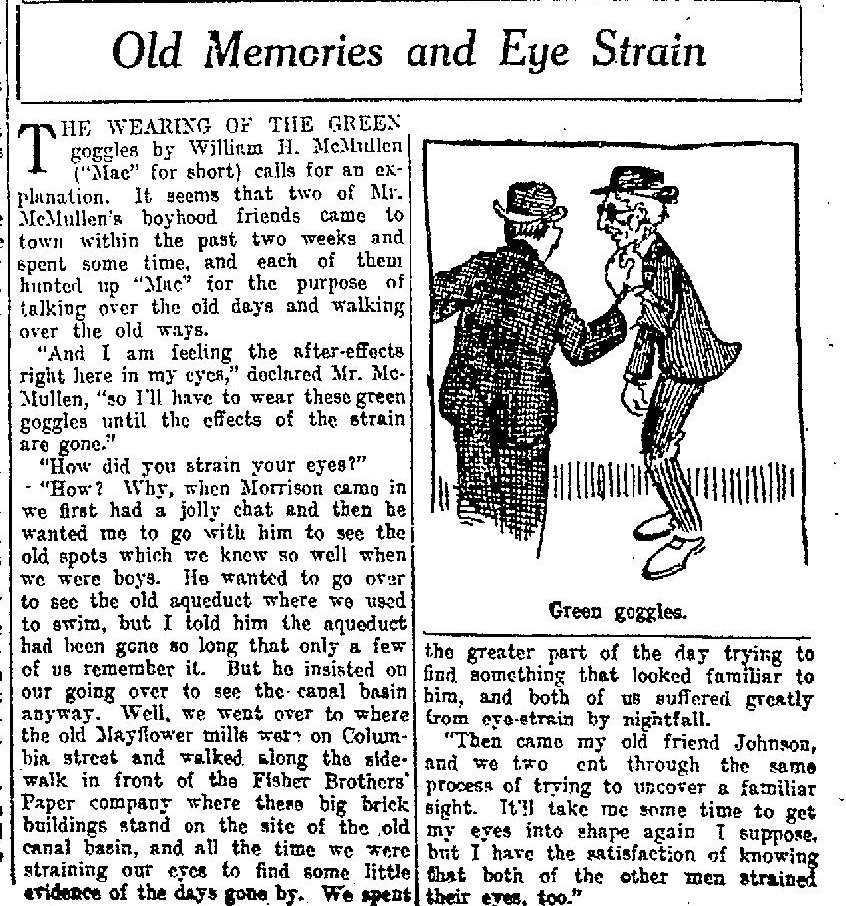
The Sentinel put this on its front page on 1 October 1913 under a heading in display italic, "Old Memories and Eye Strain," and set a drawing into it. The cartoon shows two men in overcoats and bowlers, one of them in spectacles, leaning towards each other in the street. The caption under it is two words.
Green goggles.
Nobody in the item is presented as grieving. McMullen is a man with an anecdote, delivered in the manner of a complaint about his eyes, and the paper printed it the way it would print any small thing that happened to somebody the town knew by a nickname.
The men who could not find the canal had swum in it. That is the measure of how fast the ground had been covered. Not a century, not a generation that had to be told about it afterwards, but one lifetime, with the witnesses still walking around in it and still able to name the streets. The buildings that stood on the basin were new enough to be described by whose they were. The mills were remembered as old. And the aqueduct, which had been a place where children went in the summer, had reached the point where a man had to warn his friend in advance that there would be nothing to see.
What the item does not say is when any of it went. It gives no date for the aqueduct, no date for the basin being filled, and no year for when the paper company built. It does not say how old the three men were, what McMullen did, or where he lived. It does not name the year they were boys. Everything in it is measured against a memory rather than against a calendar, which is what makes it a document about forgetting rather than a record of when things were pulled down.
Three men, two days, and nothing familiar. They had the satisfaction, McMullen said, of all having strained their eyes together.
Sources
- Fort Wayne Sentinel, 1 October 1913, 1913. Internet Archive. The item headed Old Memories and Eye Strain, with the drawing captioned Green goggles, printed page 1, scan leaf n0
The text was read from scanned images. Every quotation was checked against the page image. The item is complete on the front page and nothing carries over to another leaf.
More from Fort Wayne
Fort Wayne
More than they are either able or willing to bear
In June 1853 Fort Wayne had 1,200 school children and no public schoolhouse. The editor of the Sentinel wrote that a school tax might be more than the city could bear, and the voters turned it down, 325 to 130. Five years later he was elected a school trustee.