The day's deaths
Published .
Shortly before noon on Saturday 31 March 1894, a moulder's wife died on South Calhoun street in Fort Wayne after a long illness. Her husband worked at the Bass foundry. She was twenty-seven.
By that afternoon her death was in the Sentinel, and the paper had a place ready for it. The place had a name set in type across the top of the column.
THE DAY'S DEATHS.
Under it ran three sub-headings, a running order, funeral notices under their own rubric, and a list of the whole week's dead. The column was not a scatter of notices. It was a department.
Five deaths ran under it that morning.
George Jourdan died the afternoon before at his home in Wayne township. He was seventy-two, he was one of the old settlers of Allen county, and he had several sons living in the city. The paper said dropsy was the cause. His funeral would be Monday morning at ten o'clock from St Paul's Catholic church, and one of his sons kept a saloon on Harrison street.
Mrs Henry Walda was the moulder's wife.
Mrs. Henry Walda, aged twenty-seven, died at her residence on South Calhoun street, shortly before noon today after a lingering illness of consumption. Her husband is the well known moulder at the Bass foundry. No arrangements have been made for the funeral.
James Reardon was already dead, and what ran was his funeral: Monday morning at nine from St Patrick's Catholic church, and then the remains to Columbia City for interment. He was fifty years, seven months and fifteen days old. He was born in County Clare, Ireland, and came to the county when he was twenty. He left a wife and five children.
The last two were small. Edward, four years old, the son of a father the paper describes as an upholsterer employed by Paul Wolf, died that morning of what it called brain fever. Helen V. Penn, two years and two months, daughter of Charles W. Penn, died at four the previous afternoon of membranous croup at her parents' house on Indiana avenue. Her funeral was set for Sunday.
Four households and four kinds of work in one column: a settler with grown sons and one of them keeping a saloon, a foundry moulder, an Irish labourer who arrived at twenty, an upholsterer working for a named employer.
Then a funeral notice under its own heading, for Mrs Barbara Rash, Monday afternoon at two from the house on Montgomery street and at half past two from St Paul's Lutheran church. Then the last rubric.
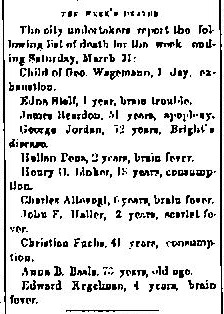
THE WEEK'S DEATHS.
The city undertakers report the following list of death for the week ending Saturday, March 31:
Eleven names followed, each with an age and a cause and nothing else. A child of one day, of exhaustion. A girl of one year, of brain trouble. Two of consumption, one of them a man of forty-one. A woman of seventy-something, of old age. A boy of two, of scarlet fever. Three separate children of brain fever.
And three of the names were the same people the column had already reported at length, with different facts attached.
James Reardon, who the obituary said was fifty years, seven months and fifteen days, is fifty-one in the undertakers' list, and the list gives a cause the obituary never mentions: apoplexy. George Jourdan, who died of dropsy in the news item, died of Bright's disease in the list, where his name is also spelled Jordan. Helen Penn, who died of membranous croup at the top of the column, died of brain fever at the bottom of it.
Nothing in the column reconciles them. The news items came from whoever called at the house or the church, and the list came from the undertakers, and the paper ran both on one page without appearing to notice that they disagreed. Mrs Rash, whose funeral the paper had just announced, is not in the undertakers' list at all.
The department was already running fifteen years earlier. On 17 September 1879 the paper printed nine interments under the undertakers' returns, and 1879 is the first year of the Sentinel this archive can read, so how much further back it goes is not a question the paper can answer here. The record does not give much else either. It does not say whether other papers in the city ran one. It does not say who compiled the daily items or who took the undertakers' returns. The five that ran that morning are what the Sentinel printed under that heading, which is not the same as all of that day's deaths in the city, and the eleven are what the undertakers reported, which is not the same as everyone who died that week.
Consumption, brain fever, membranous croup, brain trouble, dropsy, Bright's disease, apoplexy, old age, exhaustion. Those are the words the paper used. What they meant to the men writing them down, and whether two of them were the same thing, the column does not say.
Sources
- Fort Wayne Sentinel, 31 March 1894, 1894. Internet Archive. The column headed The Day's Deaths, with its sub-headings, the five news items, the funeral notice for Mrs Barbara Rash, and the undertakers' returns under The Week's Deaths, page 1, scan leaf n0
- Fort Wayne Sentinel, 17 September 1879, 1879. Internet Archive. The item headed Nine Interments, carrying the undertakers' returns with eight people named and a ninth not, page 1, scan leaf n0
The text was read from scanned images. Every quotation was checked against the page image. The scan is 2034 pixels wide and several figures in the column cannot be resolved at it: no street number is given here, and the four year old's surname, which the column sets two different ways, is not given at all.
Correction
This piece said the record "does not say when the paper began running the department". That was wrong, and it was wrong because only one issue had been searched. A search of the whole run of this paper held for 1879 to 1917 finds the undertakers' returns already printing on 17 September 1879, fifteen years before the column this piece is about, under the heading NINE INTERMENTS. The piece now says so. What remains true, and is now said plainly, is that 1879 is the earliest year held, so the corpus still cannot say when the department began.
More from Fort Wayne
Fort Wayne
The beavers had made a dam
A British force crossed the nine mile carrying place at the head of the Maumee in October 1778 and found the water beyond it too low to float the boats. What carried them down was a beaver dam, and the officer who cut it wrote down why nobody there touched the beaver.