The prayer for the dead in Latin
Published .
On a Thursday afternoon in October 1879 a woman was buried outside the consecrated ground of her church, in Perry township, with no priest present. Her body had lain in a coffin in the parlour of August Martin's house, and there were flowers around it, a cross, a wreath and a basket, sent by people she had worked for.
As she had been divorced the laws of the church forbade her being buried in consecrated ground, and no priest was allowed to officiate. While the body was being lowered into the grave an old lady, Mrs. Henry, recited the prayer for the dead in Latin.
Six men carried her: Joseph Rondot, Joseph Romary, Alexander Stirling, Frank Veith, Frank Chaney and August Pechin. The flowers were "kindly donated by former employers of Mrs. Duplein in this city."
The paper calls her Mrs Duplein. In a later item it calls her Mrs Mills, which is what she had been before, and it names her son Leonard. It names her pall bearers, her employers and the woman who said the Latin over her. It never gives her first name. Across every issue that mentions the case, she is a surname and a marital status.
Her husband had killed her two nights before and then killed himself. The paper called it a double tragedy and printed the details for a fortnight. What it printed most of was what happened next to him.
His body was taken to Peltier's stable and looked on by a goodly number of the curious. Then the medical men arrived.
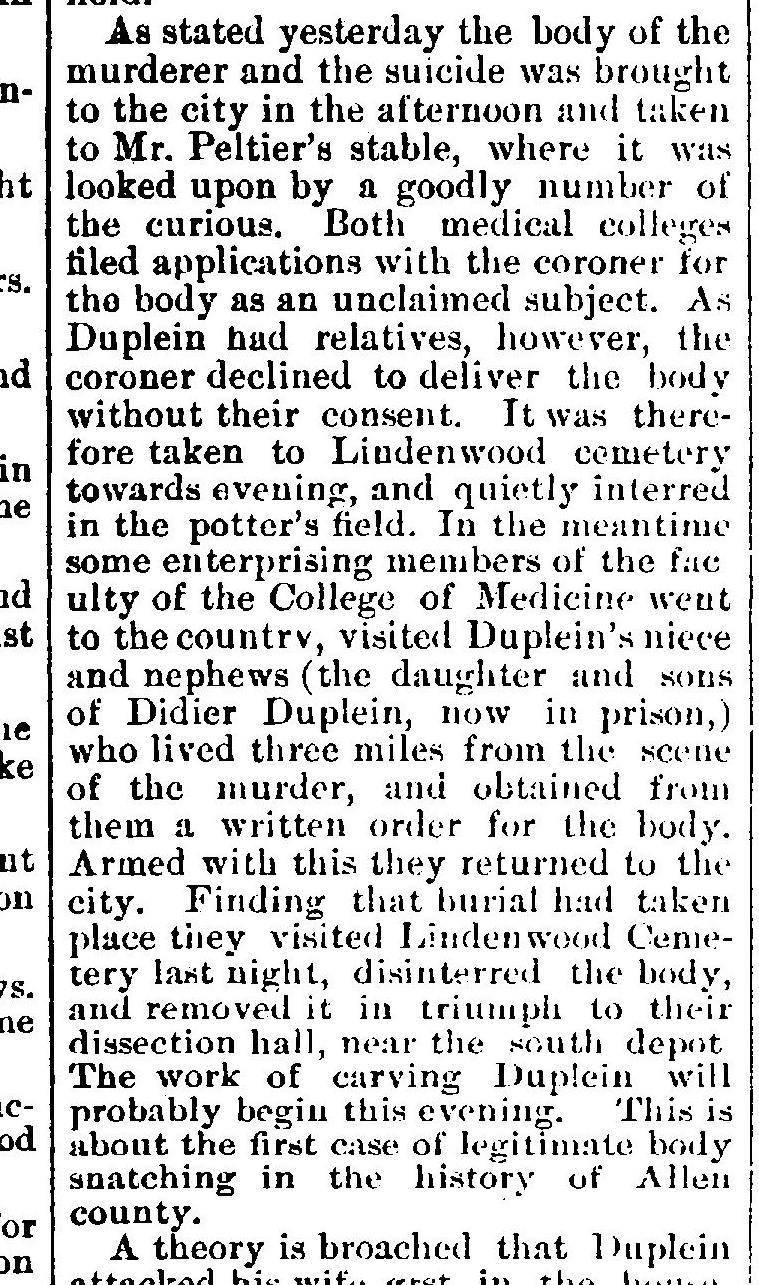
Both medical colleges filed applications with the coroner for the body as an unclaimed subject. As Duplein had relatives, however, the coroner declined to deliver the body without their consent. It was therefore taken to Lindenwood cemetery towards evening, and quietly interred in the potter's field.
A man had killed a woman and himself, two colleges wanted what was left, and the county official who could have handed it over said no, on the narrow ground that there were people entitled to be asked.
They went and asked.
In the meantime some enterprising members of the faculty of the College of Medicine went to the country, visited Duplein's niece and nephews (the daughter and sons of Didier Duplein, now in prison,) who lived three miles from the scene of the murder, and obtained from them a written order for the body.
The children signing that order had a father in the state prison. The paper says so in a parenthesis and moves on.
Armed with this they returned to the city. Finding that burial had taken place they visited Lindenwood Cemetery last night, disinterred the body, and removed it in triumph to their dissection hall, near the south depot. The work of carving Duplein will probably begin this evening. This is about the first case of legitimate body snatching in the history of Allen county.
The next day the paper counted up.
The Fort Wayne College of Medicine won the victory in the contest for the body of Fox, who died at the City Hospital yesterday. His body was taken to the college building at 4.30 yesterday afternoon. There are now three subjects at the college, Duplein, Fox and a pauper who died recently at the infirmary. The new law is working well.
Three bodies in one week. One was a murderer taken out of the ground on a signature. One died in the City Hospital and was won in a contest. The third is not named, and the only thing the paper says about him is where he died.
Four days after that it counted them again, differently.
The Fort Wayne College of Medicine is not partial to nationality. They have now floating around in their pickling vat Fox, an Irishman, Schmidt, a German, and Duplein, a Frenchman.
Schmidt had not been in the earlier list, so by the middle of the month there were four.
Nothing read after that returns to any of them. The paper does not say what became of the bodies, whether anyone objected, or what the law was that was working well. It does not say which of the two colleges was the other one. It gives the murderer's birthplace, down to the district and the canton, and it spells his first name two ways, Francois in one issue and Francis in another.
It gives all of that. It never gives hers.
Sources
- Fort Wayne Sentinel, 9 October 1879, 1879. Internet Archive. The paragraph carrying the two colleges' applications to the coroner, the refusal, the burial in the potter's field at Lindenwood, the written order obtained in the country, the disinterment and the line about the first case of legitimate body snatching in the history of Allen county, scan leaf n7
- Fort Wayne Sentinel, 10 October 1879, 1879. Internet Archive. The funeral, the church's refusal of consecrated ground, Mrs Henry's prayer in Latin and the pall bearers, scan leaf n7; and the three subjects at the college with the line that the new law is working well, scan leaf n6
- Fort Wayne Sentinel, 14 October 1879, 1879. Internet Archive. The paragraph registering the bodies in the college's pickling vat by nationality, scan leaf n7
- Fort Wayne Sentinel, 10 November 1879, 1879. Internet Archive. The account of the suit against the estate, naming Francis Duplein, Mrs Mills and her son Leonard, scan leaf n7
The text was read from scanned images. Every quotation was checked against the page image. The paper spells the dead man's first name Francois in one issue and Francis in another; both stand here as printed. It never gives his wife's first name.
More from Fort Wayne
Fort Wayne
Only a few of us remember it
In 1913 two boyhood friends came back to Fort Wayne and asked William McMullen to show them the canal they had swum in. They walked Columbia street for two days and found nothing, and the Sentinel printed it as a joke with a cartoon.