Fragments of the rock
Published .
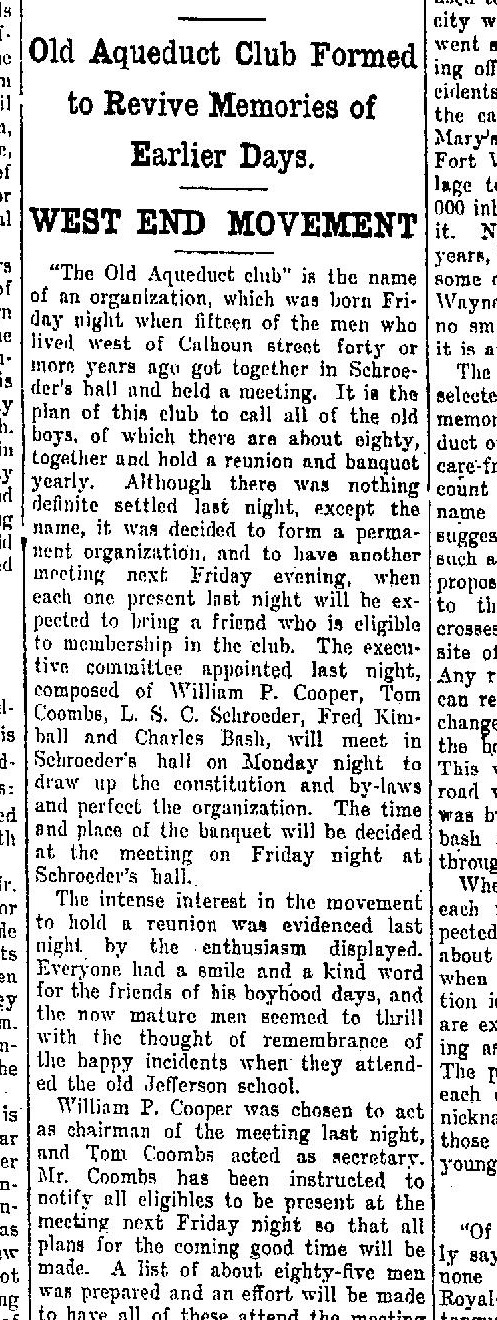
Fifteen men came into Schroeder's hall on a Friday night in November 1912 and sat down together. They had all lived west of Calhoun street forty years before or more. Most of them had gone to the old Jefferson school. They had come to decide what to call themselves.
Charles W. Orr had a suggestion, and the paper recorded both the name and the reason for it.
The name, "Old Aqueduct club," was selected in order to bring back fond memories of the days of the old aqueduct on the canal; to recall the pleasant, care-free hours spent there, and to recount the boyhood pastimes when that name is mentioned.
All favoured the proposal. Then the paper told its readers where it had stood.
The old aqueduct stood just to the right of where Main street crosses the St. Mary's river, or on the site of the present Nickel Plate bridge.
The thing they had named themselves after was gone. What they wanted was the swimming in the old canal, the diving off the old exchange bridge, the skating on the St. Mary's. The Sentinel ran it under a heading that named the impulse exactly.
Old Aqueduct Club Formed to Revive Memories of Earlier Days. WEST END MOVEMENT
Nothing was settled that night except the name. They decided to form a permanent organization, to meet again the following Friday, and that everyone present should bring a friend who was eligible. William P. Cooper took the chair and Tom Coombs acted as secretary, and Coombs was instructed to notify all the eligibles. An executive committee of five, Cooper, Coombs, L. S. C. Schroeder, Fred Kimball and Charles Bash, was to meet on the Monday to draw up a constitution and by-laws.
They thought there were about eighty of them out there. By the end of the evening a list of about eighty-five names had been prepared.
It is the plan of this club to call all of the old boys, of which there are about eighty, together and hold a reunion and banquet yearly.
They did it. The banquets ran at the Elks' Temple, the second in December 1913, the fourth in December 1915, by which time the club expected more than a hundred members and a retiring president acted as toastmaster. The programme for one of them has a piano solo, five minute talks by members, and a reading of letters from those who could not come. In December 1916 they elected a new set of officers. One December item records of a man who had died the previous month that he was a member of the club.
Then, in the winter of 1916, the ground they had named themselves after was dug up.
The city was putting a sewer along the bed of the old canal to reach the St. Mary's river, and the contractors met the abutments of the aqueduct still in the ground where the men had swum.
In trenching for a sewer along the bed of the old canal to reach the St. Mary's river the Moellering Construction company has been having hard times pecking its way through the abutments of the old aqueduct, about which clusters the sentiment, traditions and memories of the Old Aqueduct club. The company has found the limestone of the abutments like granite.
Fragments of the rock are being presented to members of the Aqueduct club as souvenirs.
A construction company cutting a trench handed out pieces of a demolished aqueduct to the men who had named a club after it. Whether anybody asked for them, the paper does not say.
Three men went looking for the same canal a year later, and they are not these men: no name appears in both accounts, and neither item mentions the other.
What the club did afterwards is not in this file. The run of the paper held here stops in 1917, with the club still electing officers the December before, so whether it wound up or simply outlasted the record is not a question the Sentinel can answer. The eighty-five names on Tom Coombs's list are not printed anywhere read. Of the fifteen in Schroeder's hall that night, six are named and nine are not.
A generation of men who had grown up on a canal outlived the canal, then outlived the aqueduct, and formed a club so that once a year they could be in a room where the thing still existed. And when the last of it came out of the ground, it came out as limestone hard as granite, in pieces small enough to put in a pocket.
Sources
- Fort Wayne Sentinel, 23 November 1912, 1912. Internet Archive. The item headed Old Aqueduct Club Formed to Revive Memories of Earlier Days, West End Movement, running down one column and continuing into the next, scan leaf n3
- Fort Wayne Sentinel, 23 February 1916, 1916. Internet Archive. The paragraph on the Moellering Construction company trenching for a sewer along the bed of the old canal and pecking through the abutments of the old aqueduct, scan leaf n1
The text was read from scanned images. Every quotation was checked against the page image. The 1912 item runs down one column and continues into the next, and both were read. The counts of how often a phrase appears were taken from a local full text index of the whole run of this paper held for 1879 to 1917, 9,463 issues.
More from Fort Wayne
Fort Wayne
A man there is so much trust put in
An English captain at the Miami town in 1781 could not read the accounts he was signing or follow the councils he was reporting, and leaned on one trader for both. That trader is why a French colonel rode four days across country to rob a single building at the forks.