In lively demand
Published .
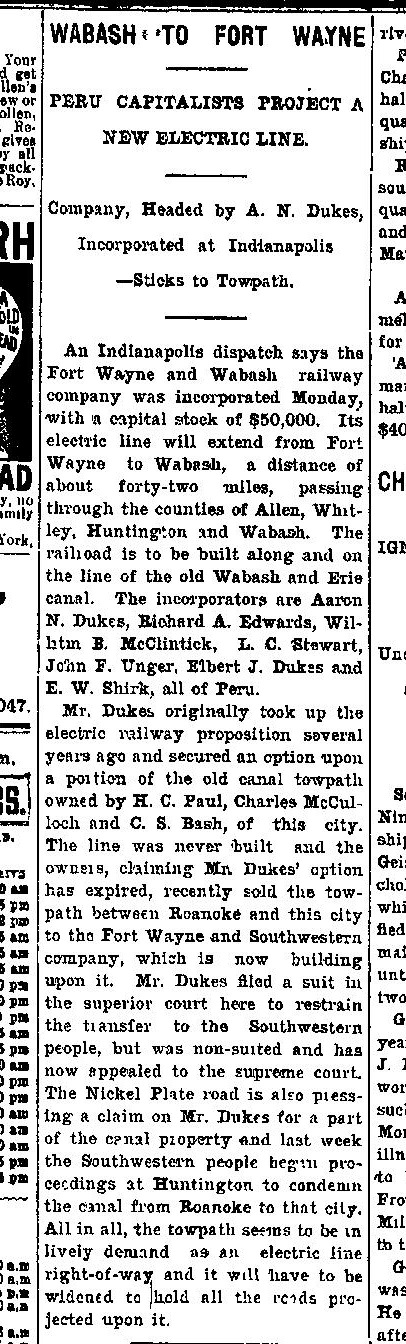
In the spring of 1901 a man from Peru named Aaron N. Dukes took a dispute over a strip of ground to the supreme court of Indiana. The ground was the towpath of the Wabash and Erie canal, the bank the mules had walked on, and by then it had been out of use for a generation. Three men in Fort Wayne owned a portion of it.
On 2 April the Sentinel printed an Indianapolis dispatch under a heading that put the point in four words: Sticks to Towpath.
An Indianapolis dispatch says the Fort Wayne and Wabash railway company was incorporated Monday, with a capital stock of $50,000. Its electric line will extend from Fort Wayne to Wabash, a distance of about forty-two miles, passing through the counties of Allen, Whitley, Huntington and Wabash. The railroad is to be built along and on the line of the old Wabash and Erie canal.
Seven men incorporated it, and the paper names them all: Aaron N. Dukes, Richard A. Edwards, William B. McClintick, L. C. Stewart, John F. Unger, Elbert J. Dukes and E. W. Shirk, all of Peru.
Then the dispatch turns to what Dukes had been doing for several years before that.
Mr. Dukes originally took up the electric railway proposition several years ago and secured an option upon a portion of the old canal towpath owned by H. C. Paul, Charles McCulloch and C. S. Bash, of this city.
That sentence is the whole of what the record gives about the three Fort Wayne men. It gives their names, it says they owned a portion of the old canal towpath, and it says they were of this city. It does not say how they came to own it, when, or what they paid. It does not say what else they did.
What it says next is what they did with it.
The line was never built and the owners, claiming Mr. Dukes' option has expired, recently sold the towpath between Roanoke and this city to the Fort Wayne and Southwestern company, which is now building upon it.
So the ground had been promised once and sold again, and the second buyer was already at work on it. Dukes went to court.
Mr. Dukes filed a suit in the superior court here to restrain the transfer to the Southwestern people, but was non-suited and has now appealed to the supreme court.
He was not the only claimant. The Nickel Plate road was pressing a claim on him for a part of the canal property. And in the week before the dispatch was printed, the company that had bought the towpath went to law itself, at Huntington, to condemn the canal from Roanoke to that city.
The paper then does the arithmetic out loud.
All in all, the towpath seems to be in lively demand as an electric line right-of-way and it will have to be widened to hold all the roads projected upon it.
Four parties are on the same strip of bank in one item: a Peru company incorporated that Monday, a Fort Wayne company already building, a trunk line pressing a claim, and three men in Fort Wayne who had sold it.
A canal is a long thin piece of property, level, cleared, and already running from one town to the next. When the boats stopped, that did not stop being true. The last commercial voyage on this canal ran in 1875, and this is what the ground was worth twenty-six years later: not as a waterway, but as a line.
There is a great deal the item does not give. It does not say what the Fort Wayne and Southwestern paid, or what Dukes had paid for his option, or what the Nickel Plate's claim rested on. It does not say how the supreme court decided. It does not say whether the Fort Wayne and Wabash company, incorporated that Monday with fifty thousand dollars, ever built anything at all. Of the three men who owned the towpath it gives three names and one sentence.
What it does give is a date and a direction. On the second of April 1901 the bed of the Wabash and Erie canal between Roanoke and Fort Wayne was owned by one company, wanted by three parties, subject to a condemnation suit at Huntington and an appeal at Indianapolis, and being built upon while the appeal was pending.
Sources
- Fort Wayne Sentinel, 2 April 1901, 1901. Internet Archive. The item headed Wabash to Fort Wayne, Peru Capitalists Project a New Electric Line, Sticks to Towpath, carrying the incorporation, the option, the sale of the towpath, the suit and the condemnation proceedings, scan leaf n4
The text was read from scanned images. Every quotation was checked against the page image. The item is one column and the hero carries all of it, from the heading to the last line.
More from Fort Wayne
Fort Wayne
The beavers had made a dam
A British force crossed the nine mile carrying place at the head of the Maumee in October 1778 and found the water beyond it too low to float the boats. What carried them down was a beaver dam, and the officer who cut it wrote down why nobody there touched the beaver.